
The Last Hour Is Not a Planning Failure
The days before a big meal run on one ambition: have as much as possible already done. Some components are only at their best in the last hour, and moving them earlier is exactly what damages them.
meal prepkitchen notesfall cooking
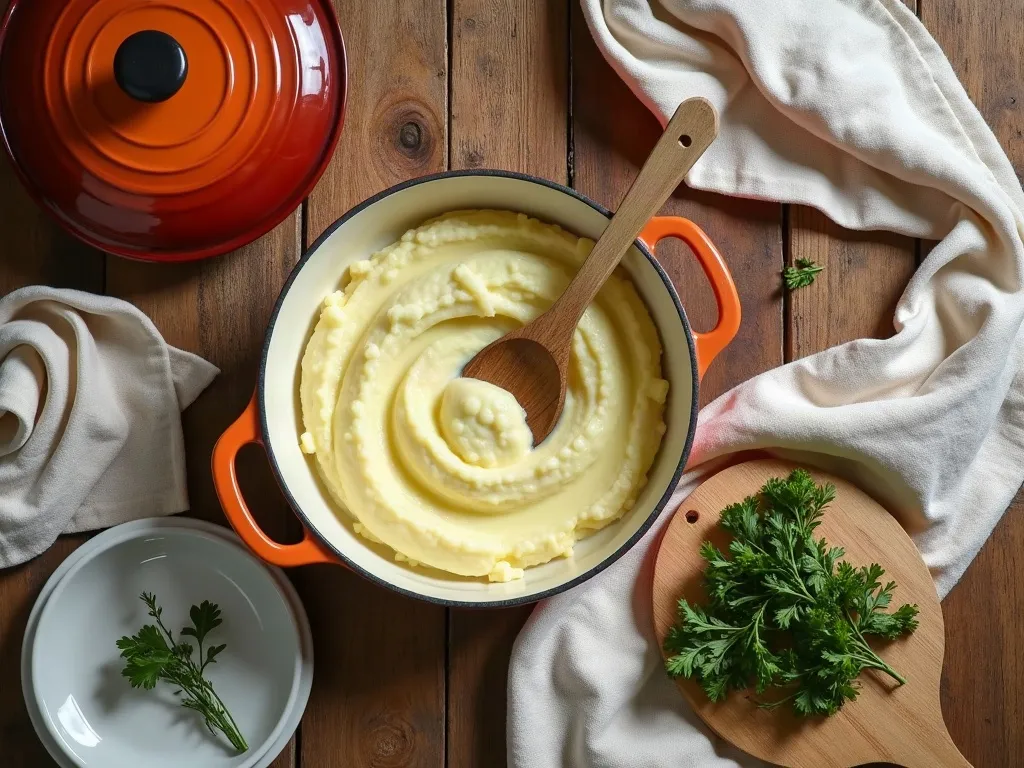
The days before a big meal run on a single ambition: by the time the day arrives, as much as possible should already be done. It is the right instinct and it is half wrong, and the half that is wrong costs more work than the half that is right saves.
Cooked and ready are different moments
A dish finishes twice. Once when it comes off the heat, and once when it is in the state you would want somebody to eat it in. For most of a menu those two moments are the same minute, which is exactly why the distinction never gets said out loud.
Mashed potato is the clearest case. It is cooked in twenty minutes and at its best about thirty seconds after the last turn of the spoon. Spoon it into a dish, cover it, carry it to the fridge, and by the time it comes back to the table it is dense and close-grained, and stirring it only makes it denser. Nothing went wrong in the making. It was simply made early.
That is the whole argument, and it has nothing to do with potato. There is a set of dishes whose good quality is not an ingredient but a condition — a crisp edge, a cut face, a bit of air, a dry crust — and those are the ones a covered box takes something from overnight. The other direction, the food that genuinely improves with waiting, has already been argued where it belongs: the pot that goes in the oven makes the case that day two is the actual product, and it does not need making twice. This is the other column.
A cold box works on surfaces
A refrigerator is not a neutral place to leave something. It is cold, it is damp, it moves air around, and it smells of everything else in it. That is roughly the opposite of what a surface wants. The fried shallots that were going to be the good part of the beans come out tasting of the inside of the fridge. The herbs chopped on Monday have gone dark along every cut, and the perfume that was the entire point of them has gone flat. Cream whipped stiff at nine in the morning is a puddle by four. An apple sliced ahead is brown at the cut faces and soft underneath them.
None of those is a cooking failure, and none of them can be repaired at the table. They are one mistake made four times: the work was moved earlier because moving work earlier is supposed to be free.
The ones that were never going to wait
Most of what goes wrong in the last hour goes wrong because the last hour was treated as an emergency. It isn’t one. You are standing in the kitchen anyway; the only question is what you are standing there for.
The dishes that belong in that hour are the ones whose virtue is a surface:
- anything fried or crisp, and anything scattered over the top for texture
- herbs, chopped at the end — left whole on the stem they hold far better than cut
- mash, polenta, anything whose texture is air and heat
- fruit cut for the table
- leaves with dressing already on them, which is the clearest instance and already has its own argument
Everything else can move. The braise, the stock, the sauce, the cranberry, the stuffing that wants to sit and soak — all of it is happy to be made on Monday and eaten on Thursday. That is the part of the list the week was built for.
Split the dish, not the hour
A marked line is not a line you have to leave until the last minute whole. Almost every surface dish has two halves: the work of assembling it, and the ninety seconds that make it what it is. The first half can move and the second half cannot, and separating them is most of the skill.
Take the herbs. Picking the leaves, washing them, drying them properly and leaving them whole on the stem is twenty minutes of fiddly work that is much better done when you have twenty minutes than when you have four. The cutting is the part that has to wait, and it takes no time at all. Same with the crisp thing: the shallots can be sliced and the oil measured and the tray lined today. What cannot happen today is the frying. Mash is the one that genuinely cannot be split — the whole dish is the last ninety seconds — which is why it is the dish that most often gets made twice.
The second pot is the real cost
This is where the wrong column gets expensive. A dish made early and then found to be past its best is not a dish saved; it is a dish made twice, once for the fridge and once for the table, with the first pot eaten grimly on Wednesday as a punishment. Anyone who has done it knows the arithmetic: an hour on Monday, another hour on Thursday, and a portion nobody enjoyed in between.
The fix is not more discipline. It is deciding, before the week starts, which lines on the menu were never going to be early, and then not arguing with them on the day. A dish that is scheduled for the last hour cannot be a disappointment. It is doing precisely what it was meant to do.
Mark the menu, not the recipes
The practical version takes ten minutes and a pencil. Read the menu — not the recipes, the menu — and ask of each line one question: is this dish’s best quality a surface? The lines that get a mark are the last hour’s work by definition, and no amount of earlier effort will change that.
What it buys is an hour with a shape to it. If Thursday’s remaining jobs are the mash, the herbs, the crisp thing and the dressing, then the last hour stops being a scramble and becomes a sequence — and the rest of the day can be built around the oven instead of around a feeling. That is where the oven plan belongs: serving time first, then the dishes sorted by what they ask of the heat. It only holds together if the surface dishes have been kept out of the oven’s list on purpose.
The hour is the point
There is a version of getting ahead in which everything is done by the night before and the meal is assembled out of containers on the day. It photographs well. It eats like a tray of catering. The last hour is not the part of the plan that failed; it is the part where the food becomes the thing that was intended — the mash still light, the herbs still green, the top still crisp.
The work that can move should move. The work that cannot should be expected, and expected early, in writing, on the menu. Both of those are planning. Only one of them feels like it.