
A Stale Loaf Is Only Half Done
The last third of a loaf gets thrown out in kitchens that spent the afternoon cooking. Drying is not decay — it is the step before crumbs, croutons and a baked dish, and it costs nothing but a tray on the counter.
kitchen notesbakinggrocery planning
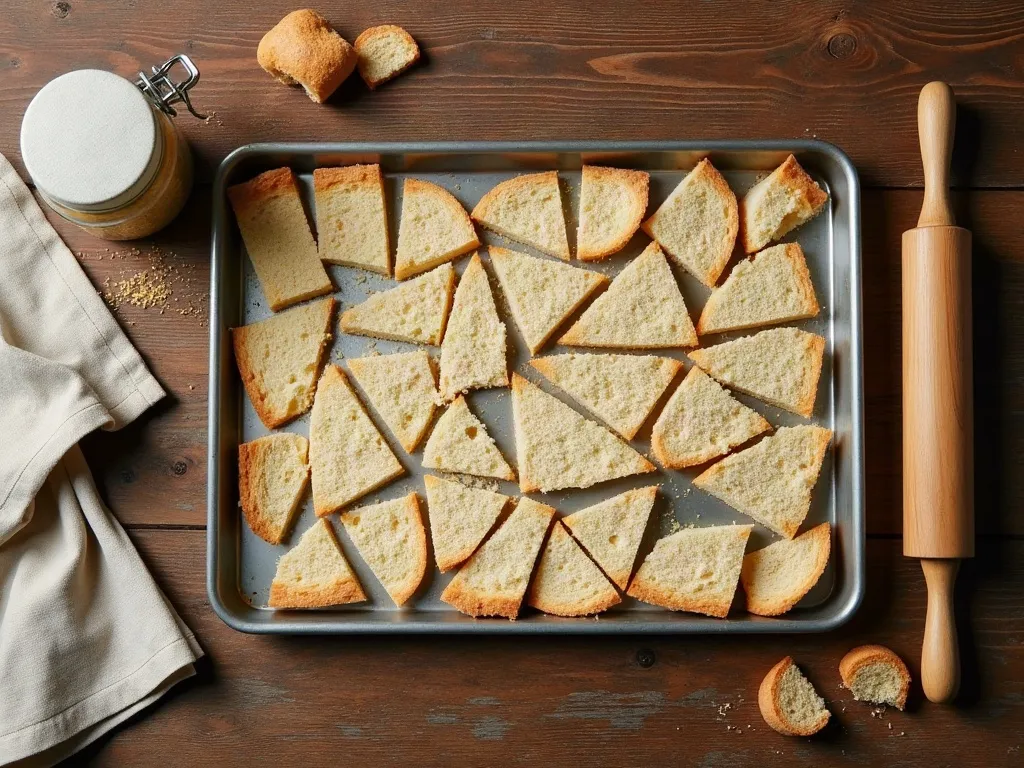
The last third of a loaf has a way of sitting on the counter in its bag until somebody decides it has become a chore. It is not bad yet. It is simply no longer what it was bought for — sandwiches, toast, something to put butter on — so it joins the row of things waiting to be dealt with, next to the half onion and the jar with a spoonful left in the bottom. Then one evening it goes out with the peelings, and the kitchen has thrown away the cheapest ingredient it had.
That is a strange thing to do in a room that has been cooking all afternoon.
The loaf is finished before it goes stale
Half a loaf is not a smaller loaf. The first half was bread and did the job bread does. What is left is a different ingredient that happens to be shaped like the first one, and it does not want to be rescued — it wants a destination. Once there is one, nothing about the loaf has gone wrong. It is in the middle of a process that ends in a jar of crumbs instead of on a plate.
The kitchen already knows this. Late in November it is the most ordinary thing in the world to tear a loaf into pieces and leave it out on a tray to go hard, because that is what the stuffing wants, and everybody understands that the drying is the preparation rather than a delay before it. The other fifty weeks of the year the same loaf goes dry on the counter and gets called a failure. The bread behaves identically. The only difference is whether anybody decided in advance what the dry loaf was for.
The loaf is not being saved. It is being finished.
Dry is the point, not the problem
Crumbs are not made from bread that has been ground up. They are made from bread that has been dried, and the grinding is only the last step of a job that began when the loaf came out of its bag. So the useful move with a loaf that has begun to firm up is not to rescue it. It is to finish the drying on purpose, while the kitchen is still awake and the oven is still warm from something else.
Tear it rather than slice it. A torn edge has more surface than a cut one, and tearing leaves the pieces ragged in a way that stops them packing into a solid block. Spread them on a tray in a single layer, leave the tray on the counter, and turn it once the next time somebody walks past. The air will do the whole job and it will not overdo it. A low oven with the door ajar does the same work faster, but it wants watching: the distance between properly dry and toasted brown is short, and brown crumbs are a different ingredient with a louder voice — one that announces itself in whatever it goes into.
Three destinations, and what each one wants
- Crumbs want bread dry all the way to the middle and no darker than gold. Break it up in a bag with a rolling pin, or in the machine, in small batches — a full bowl turns the bottom into paste while the top is still chunky.
- Torn croutons want bread that is dry at the edge and still slightly soft inside, torn rather than cubed, tossed with fat and salt, and given a pan in one layer. Crowding is what makes them chewy, and a chewy crouton is a piece of toast that has been through a hard time.
- A baked dish of bread, milk and egg wants bread dry enough to drink the milk. Fresh bread takes the same milk and turns soft in a way that never quite sets; a dry loaf takes it and stays itself, which is the difference between a bake and a pudding nobody ordered.
All three start on the same tray. The only decision is when to take it off.
What a jar of crumbs is for
A jar of crumbs is the answer to a whole class of small problems, and it is the reason the loaf is worth the trouble. It goes on top of a bake so the top has an edge, and coats a cutlet so the cutlet has one. It thickens a mixture too loose to hold, without anybody stopping to decide what kind of thickener it is. And it means a recipe that asks for a cup of crumbs no longer needs a shop, which on a weekday evening is the difference between dinner and a good intention.
The bag also absorbs the ends that have no other use. The heel of the loaf, the last two rolls from a bag that came with something else, the half baguette that was a good idea at the shop — they all go on the tray and then into the bag, and the bag slowly becomes a record of everything the kitchen has baked and not finished. Nothing here has to be measured, timed or planned at the start of a week. It is one tray and one bag, and it works in the corners of evenings that were going to happen anyway.
What it will not do
The one thing a stale loaf will not do is become bread again. There is a trick — a splash of water and a few minutes of heat — and it works, for as long as the loaf is still warm. It comes out with a crust that gives, the table is briefly convinced, and then it cools and is drier than before it went in. That is worth knowing, because it gets one more round of toast out of a loaf that is nearly gone. It is not a way to get a loaf back. Once that is accepted, the tray stops being the last resort and becomes the obvious move.
Put it on the door list
A bag in the freezer door needs the same thing everything else in there needs, which is to be written down. The door list taped inside the freezer has room for one more line, and crumbs are the easiest line on it to forget: a bag of beige things is invisible, and a bag nobody can see gets made again while the old one sits behind the ice.
What this week is for
For the next few days this kitchen will do the whole thing deliberately, the way it does every year at this end of November: a torn loaf out on a tray, going hard, because something on Thursday needs it. It is the one week when the drying is called preparation and nobody apologises for the tray on the counter. The rest of the year the same loaf, the same tray and the same dry air are here for the taking, and the only thing missing is having decided, once, that the second half was worth planning for.
The loaf itself comes out of the cold-kitchen method that gets used all winter — a slow rise in a cool room, which is the forgiving way to bake and also the way a kitchen ends up with more bread than it can eat. What happens to it afterwards is not the loaf’s problem. It is the tray’s.