
The Cook Is the Last One to Eat
The person who makes dinner spends the hour before it tasting, and by the time the plates go out their own appetite has been spent on questions. Notes on the smallest plate, the nine o'clock raid, and the one change of order that gives the cook their own dinner back.
kitchen notesweeknight dinnersexplainer
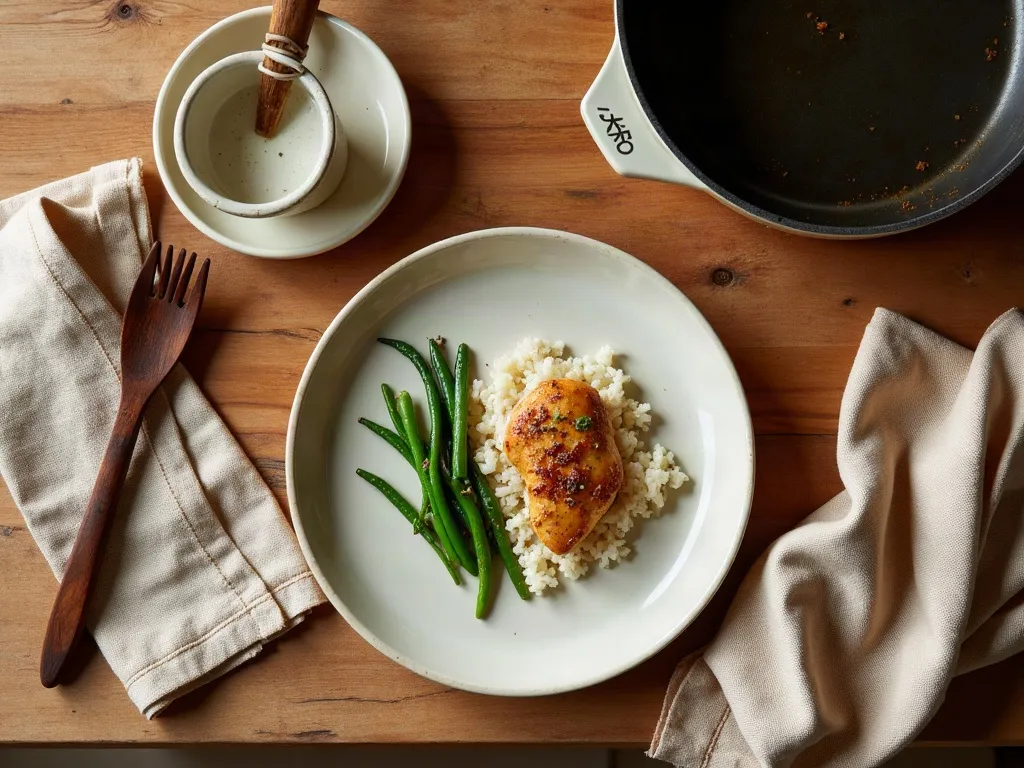
At twenty to seven the pot is nearly right, and the person who made it knows it is nearly right because they have been tasting it for the last half hour. A spoon goes in, comes up, gets blown on, goes in the mouth. A little more salt. Then a spoon of the sauce, because the salt went into the sauce rather than into the pot. Then a piece of the vegetable, to see whether it has given up yet. By the time the pot is right, seven or eight spoons have been past the lips and none of them were dinner.
The plates go out at ten past. Four of them are full. The fifth is at the end of the counter, smaller, because by then the food has stopped looking like something to eat and started looking like a job that is nearly finished.
Tasting is a question, not a bite
Every one of those spoons was asking something. Is this salted enough. Has the onion stopped being sharp. Does it want the lemon now, or after. They are small questions and they are all worth asking, and the answers are the difference between a dinner that works and one that is nearly there — which is most of what separates cooking from following instructions.
The trouble is that the tasting and the eating are done with the same mouth. A taste is a question, but the answer arrives on the tongue, and the tongue does not file it as a question. Thirty of them over an hour is not much food. It is enough to take the edge off, and the edge is exactly what somebody needs at seven o’clock.
The smallest plate, served last
Serving order is a small thing that gets decided once and then never revisited. Whoever cooked serves, because the plates are hot and the food is in the pot and everybody else is already sitting down. So the cook’s own plate is the last one filled, and by then the spoon is going into a pot that has been through four servings: the end of the joint, the last of the crisp edges, the piece that broke.
Some of that is manners and some of it is genuine indifference. But a smaller plate, filled last, from what remains, is three decisions made in ten seconds, and all three of them point the same way.
Where the hunger goes
It does not disappear. It arrives later, which is worse. At nine o’clock the kitchen is wiped down, the table is clear, and the person who has not really eaten since half past six is standing in front of an open refrigerator with a piece of bread in one hand.
That is the same meal, eaten badly. It is also the hour when whatever takes the least effort is the easiest thing in the house to reach, and nobody is at fault: the dinner was made, it was good, and the cook was the one person at the table who never sat down to it.
Serve your own plate first
The repair is smaller than it sounds, and it is not about eating more. It is about the order.
Put the cook’s plate up first. Not last, not after the others are settled, not once the counter is clear — first, while the food is at its best and while the person who made it is still hungry. Then carry it to the table with the others and sit down with it. Two things happen at once. The dinner gets eaten hot, and the cook finds out what they actually cooked, which is not the same knowledge as watching each part taste right on the way in.
There is a smaller version of the same idea for the pot itself. Taste on a saucer rather than off the cooking spoon. A spoonful poured into a small dish has a beginning and an end and can be left half finished; the spoon that goes back into the pot can also go back into the mouth, and that is how an hour goes missing between six and seven.
The dinner that never asks to be tasted
Not every dinner does this to the cook. The 2011 slow-cooker chili in the archive is the clearest example: everything goes into the pot in the morning, the lid goes on, and nobody tastes anything all day, because there is nothing to taste — the pot is closed and the cook is somewhere else. It comes out at the end of the afternoon and the cook’s plate can be the first one filled, because no appetite was spent getting it there.
A pan dinner is the opposite by design. It wants somebody standing over it for the last twenty minutes, adjusting, and that somebody pays for the adjusting in appetite. That is not an argument against pans. It is a reason to know which kind of evening is in front of you, and to eat something at four o’clock on the days when it is going to be the second kind.
If standing up is what you actually want
There is a version of the standing dinner that is not a failure at all. Some cooks, after an hour at the stove, do not want to sit at a table and be talked at. They want ten minutes alone with a small plate, standing where the light is good and the pan is still warm. That is a real preference and it does not need correcting.
What it needs is a plate. A few things put on it deliberately — a bit of everything, including the dish that took the longest — set down on the counter with a fork, rather than a series of raids on the pan between chores. The difference between those two evenings is not the food, and it is not the standing. It is whether anybody decided.
The meal has a cook and it has eaters, and in most kitchens they are the same person, twenty minutes apart. Everything above is only about that gap: the person best placed to know whether the food is good is the one least likely to sit down and find out.
Which is why the plates that come back matter so much, and why a plate with something pushed to the rim is a harder thing to read than it looks. The cook is generally reading it from a standing position, with a spoon still in one hand.