
The Cold Half of the Plate
Lettuce stops earning its place somewhere in November, and the salad quietly leaves the table with it — which is how a whole winter of dinners ends up brown. Notes on what the cold half of the plate is actually for, what to build it from instead, and why it wants salt before it wants dressing.
seasonal producefall cookingkitchen notes
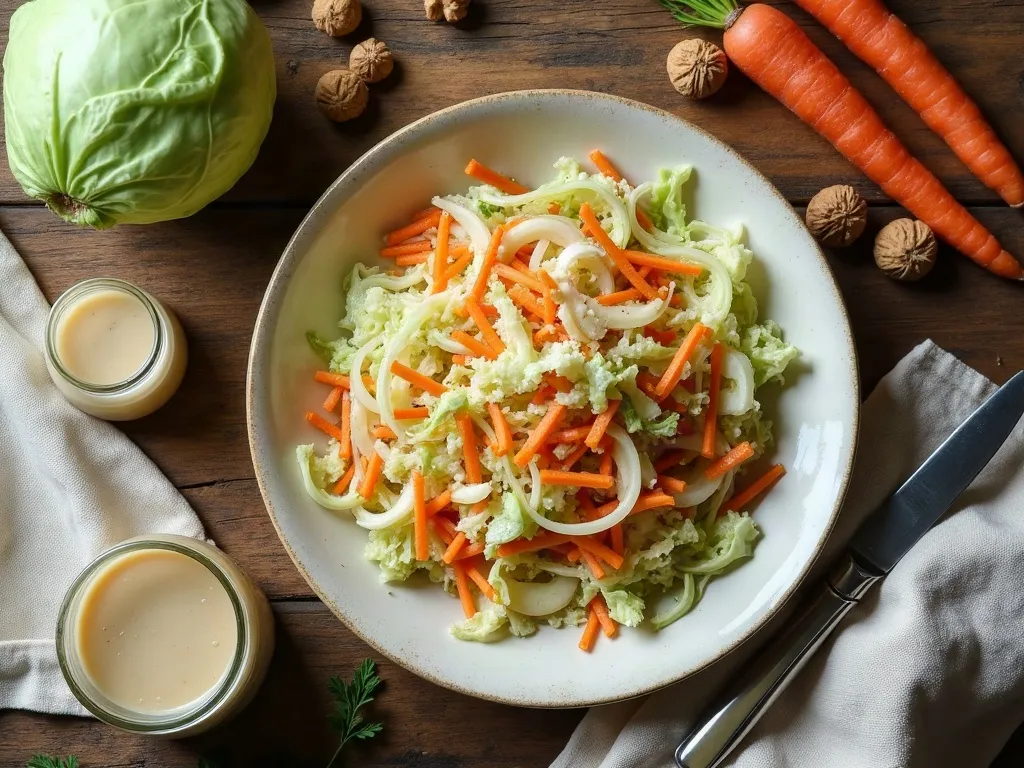
The bag of lettuce comes home in November out of habit, and it sits in the drawer until it becomes something the sink has to deal with. Nobody decides to stop making salad. It stops on its own, on some ordinary evening when the oven is on and there are three other things to do, and the one part of dinner that is assembled rather than cooked turns out to be the part that gets dropped. By January the plate has been brown for two months — a piece of meat, something roasted, a spoon of something soft — and nobody has said out loud that anything is missing.
Why it goes first
The salad is not the slowest thing on the plate; it is usually the fastest. It goes first because it is the only thing on the plate that has to be made at the last minute and finished before anyone sits down. Everything else can wait in a pan with a lid on it, or in the oven with the door shut, and be no worse for ten more minutes. A dressed salad cannot. It starts to give the moment the vinegar hits it, so every minute you spend elsewhere is a minute it spends going limp in the bowl. On a short evening it loses to the pot every time — and the loss is quiet, because dinner still arrives.
The job is contrast, not greens
A hot dinner is soft, brown, salty and warm. The cold half of the plate brings the three things it does not have: cold, crunch, and acid. That is the whole job description, and once it is written down, lettuce turns out to be one way of doing the job rather than the definition of it. A pickle does it. So does a cold slice of apple next to something rich. But a bowl does it for the whole table at once, and a bowl is the only place you can get four kinds of crunch into one mouthful.
So the question in November is not “what salad” but “what has crunch and acid in it this week”. A kitchen that answers that question keeps a salad on the table in February without ever buying a head of lettuce.
What is actually in the drawer
The drawer in November is not empty. It is just not green. Half a cabbage — the other half went into something last week, and its cut face has dried a little, which is fine once you take a slice off it. A bag of carrots. An apple or two, softening at the pace apples do. A bend of celery. The white of a leek, which nobody believes is good raw until they have had it sliced thin and rinsed. A beet, if you are in the mood for the staining. And at the back, the end of a piece of cheese and a handful of walnuts somebody opened.
The cutting matters more than the list. Cabbage as thin as you have patience for — a mandoline if it lives within reach, otherwise a knife and two honest minutes. Carrots coarse on a box grater. Apple in matchsticks. Celery on the diagonal, so the cut face can hold dressing. A leek sliced thin and then swirled in a bowl of cold water, because it comes out of the ground with grit down between the layers and it will not tell you so.
What you are assembling is not a flavour so much as a register. Something that bends — cabbage, once the salt has been at it. Something that snaps — carrot, celery, apple. Something that squeaks, which is the beet’s contribution. And something rich enough to stop the whole thing reading as a penance: the cheese, the walnuts, a spoon of something oily from a jar. The fajita page in the archive has always offered a salad version of itself, shredded lettuce and spinach in place of the tortillas, and that is the same idea from a different direction: the bowl is a shape, and what goes in it is whatever the week has.
Salt first, then walk away
The one move that turns raw roots into salad is salt, applied early and in more quantity than feels sensible. Cabbage and carrot go into the bowl, get a good pinch, get turned over with a hand, and then get left alone for ten minutes while the oven finishes whatever is in it. The salt draws the water out and the shreds relax and go glossy. What was a pile becomes a bowl of salad — softer, glossier, and able to hold a dressing instead of floating in it. Skip this and you will pour dressing over shredded vegetables that never quite become one thing, and you will blame the dressing.
Dressing is a jar, not a recipe. Oil, vinegar, a spoon of mustard, salt, pepper, lid on, shake until it goes cloudy. More oil than vinegar. The only test worth running is a piece of the vegetable itself dipped in and eaten, because a finger lies — it is warmer and saltier than a carrot, and it will tell you the dressing is fine when it is not. Pour it over, turn the bowl with your hands, and taste one more piece before it goes to the table. If it needs something, it is almost always acid or salt and not another ingredient.
Put something hot on top
The best salad of the winter is the one with heat in it. Roots out of the oven, still properly hot, laid on the cold sharp leaves — the heat wilts the edges in a way that reads as cooking and isn’t, and the two temperatures in one bowl are more interesting than either on its own. The pan they came out of goes over the top as the dressing: the fat, the browned bits, a squeeze of something acid to loosen it. A bowl built this way can carry a whole dinner that would otherwise need a second pan.
Two limits. The hot thing goes on at the last second, or the cold half stops being cold. And the bowl should be bigger than the hot thing, not the other way round — a warm salad with three roasted carrots in it is a plate of carrots with a garnish.
The cheapest thing on the plate
A salad costs one bowl, one knife and one board. In a kitchen where the sink decides what the evening can afford, that is worth noticing, because it is the cheapest thing on the table to clean up after and the one most often skipped for want of time. Ten minutes, one bowl, and the plate stops being brown.
The drawer at the end of the week is a better report on how the week went than the freezer is. A drawer with a cabbage stub and a bend of celery in it says somebody was cooking and somebody was guessing. A drawer with a bag of slime in it says the salad was dropped again, on a night when it would have taken less time than the potatoes.