
The Jobs That Are Real
A child at the counter is not a helper you can schedule, and the offer of help almost always arrives at the worst minute. Notes on the work that is genuinely theirs — the hot side, the knife question, and the mess that comes with it.
kitchen notesweeknight dinnerskid-friendly
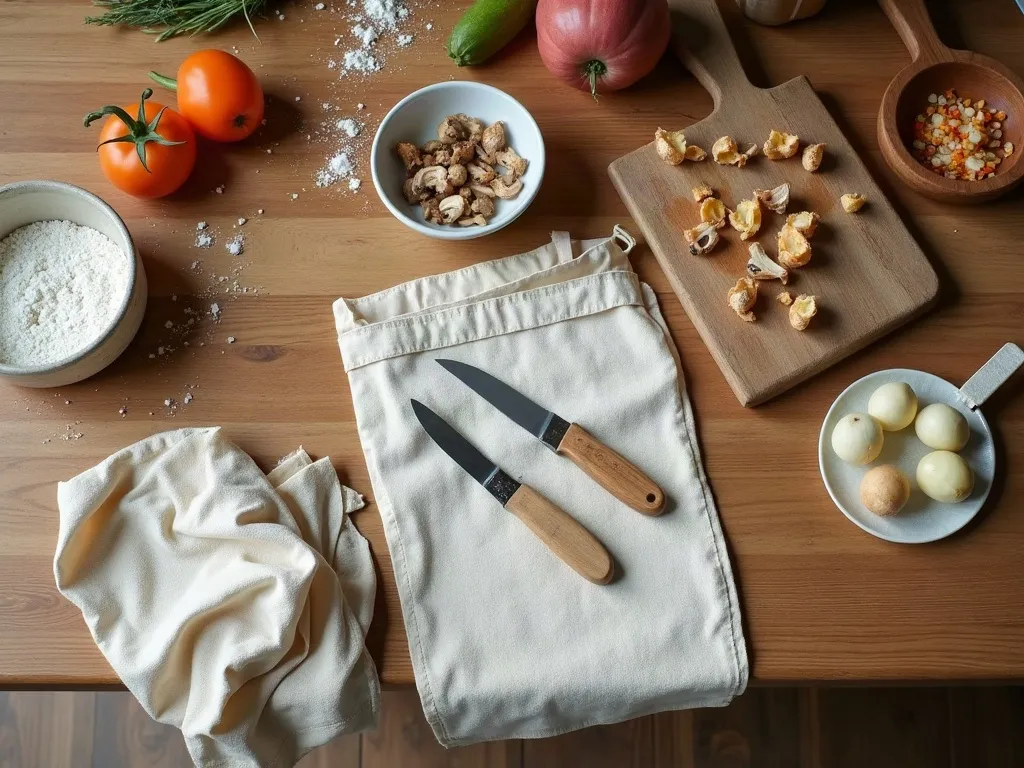
The offer of help almost always arrives at the worst minute. Not while the onions go in, which would be easy, but at the moment the pan is already hot and the next four things have to happen in a fixed order. Can I help. And the honest answer most nights is not right now — a correct answer, and over a few months of correct answers it teaches a child that the kitchen is a room where other people work.
The fix is not to make room for a helper at six o’clock. It is to keep one real job ready before the question comes, so that yes is possible without dinner paying for it.
Real work and pretend work
Children can tell the difference, and they can tell it long before they can say so. Handed a spoon and told to stir the pot that was going to be stirred anyway — gently, carefully, mind the steam — a seven-year-old lasts about forty seconds before drifting to the drawer with the whisks. Handed a punnet of mushrooms and a bowl, the same child will stand there until the bowl is full, because a bowl filling up is a visible thing that happened.
The test is simple enough to apply while the pan is hot: a real job ends with something on the table or something out of the way. Mushrooms torn into pieces. A cucumber peeled in strips. A head of lettuce separated into leaves. The bag of scraps carried to the bin. The table set with the number of plates that will actually be used, which is a harder question than it sounds. The stack of washing-up is a real job and not a punishment, so long as the child is not the only one doing it — our notes on the sink make the same case for adults.
Pretend work has a smell to it. Anything invented to keep a small person busy near the stove: the empty saucepan and the wooden spoon, the eight seconds of seasoning, the single cup washed. It buys a few minutes of quiet, teaches nothing, and children work out fairly quickly that they have been handed it.
The hot side
The boundary that holds easiest is not a set of warnings but a line in the room. The stove belongs to whoever is cooking. The counter and the board belong to the child. Same sentence every time, said once without a lecture attached — and it does not need repeating when the pan gets loud.
What that line buys is a counter that stays a safe place to be clumsy. Hovering over it undoes the whole thing: a child watched at arm’s length learns that the board is dangerous too, and that the reward for helping is being managed. Two things are absolute, and both of them are about the stove rather than the counter. Nothing gets lifted off the hob by a child, and nothing goes into a hot pan without an adult standing beside it.
The knife question
The question is not how old, it is how soft — and whether the thing will hold still while it is cut.
A table knife goes through mushrooms, a banana, a peeled cucumber, soft cheese, a ripe tomato, cooked potato, a halved apple. None of that needs an edge that could do damage; it needs a child to lean in and press, which is the actual skill being practised. The board goes down on a damp cloth so it does not walk across the counter, and anything round gets halved first so the flat side faces down.
A small paring knife comes later, and the trigger is not a birthday but the watching: the child has seen the same cut made on the same vegetable often enough to know where the blade goes, and holds the food far enough back that no finger is underneath it. The small knives in this kitchen are kept sharp, on the theory that the knife which slips is the one dull enough to need force behind it. That is house practice rather than anything a reader should take as a rule — some kitchens will hand over a knife at eight and some at thirteen, and the cook has to be in the room for the answer they give.
What it costs
Help is not free. It costs about a quarter of an hour and a flour-dusted counter, and on a Tuesday with a hard seven o’clock that is a price worth refusing. Say no on those nights without dressing it up, then choose one night a week where the slower version is the plan on purpose.
Pick the dish for it. Whatever goes into one pan and does not need precision in its face: soup, a tray of vegetables, a pot of beans, dough that will be flattened by hand. The archive’s chicken fajitas are the reliable one here, not because the marinade is child’s work but because the assembly is — a tortilla, strips, cheese, a spoon of whatever is on the counter — and dinner is partly made by the person eating it. Nothing about that supper depends on how neatly anything was sliced.
It is not a lesson
The job should not arrive with a quiz attached, and it should not be a lever for getting something eaten. A child told they will like the beans because they stirred them has been handed a second job — managing the adult’s hope — and they will decline it.
The whole reward is one sentence at the table. The mushrooms were yours. Said plainly, once, with no follow-up about what is good for anybody, and no remark about how nice it is to cook together. That sentence is what makes next Tuesday’s offer arrive at a better minute.
The stool stays out
What the counter is worth over a few years is not the food that comes off it. It is that a child who has peeled and torn and set the table and carried the scraps has a place in the room where dinner gets made, and that place does not have to be renegotiated every evening. The packed lunch that eventually gets made with nobody else in the room starts at a board with mushrooms on it, and at an adult who said yes at the wrong minute and had something real to hand over.