
A Pie Finishes on the Counter
Most of the pies get baked today, and the part that decides whether they slice or flood happens after the oven goes off. A pie is one of the few things in a kitchen that is not done when the timer is.
bakingfall cookingexplainer
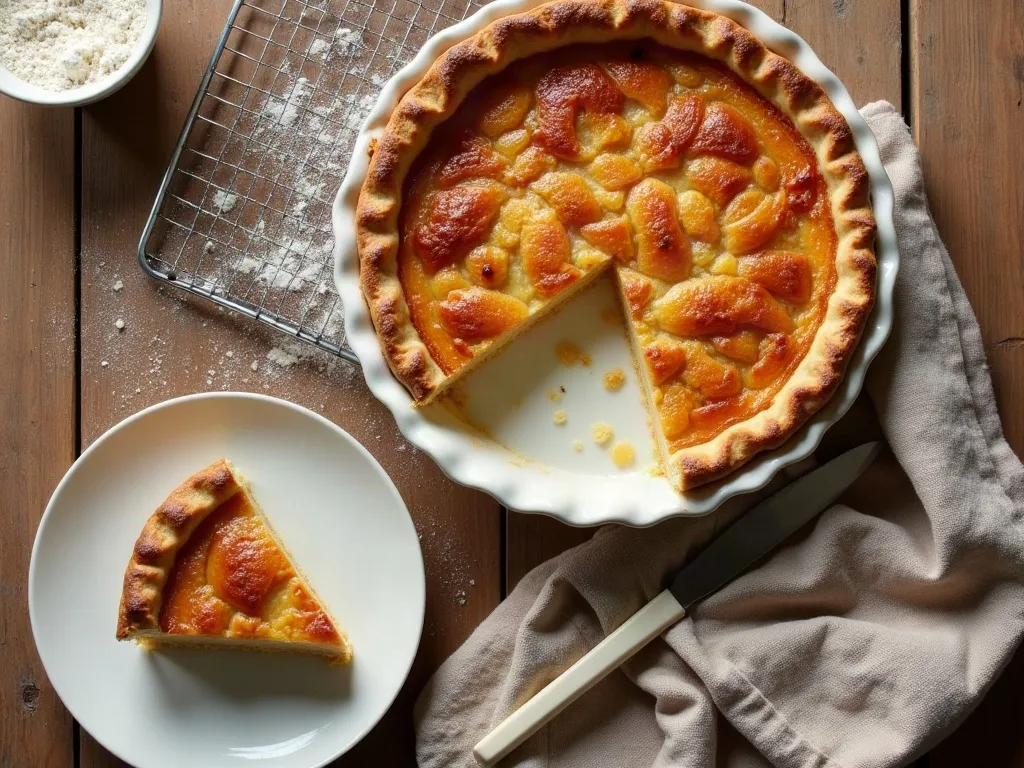
The day before the big meal is when most of the pies get made, and it produces the same small crisis in a thousand kitchens: the timer goes, the oven door opens, and the middle of the pie is still moving. It looks wrong. It is not.
The instinct is to shut the door and give it ten more minutes, and that ten minutes is usually the whole difference between a pie that slices and one that is quietly overbaked in a way nobody can name but everybody tastes. Very little else in the kitchen keeps cooking after you take it out. A pie does, and it is the one thing on tomorrow’s table whose last step is not a step at all.
The middle is supposed to move
Pumpkin, buttermilk, chess, a lemon custard — anything that sets in the oven on the strength of eggs. When it comes out, the outer couple of inches should look set and may have puffed a little, and the middle should still have a slow, wide wobble when you nudge the rack. Not something you could pour, and not a firm flat surface either: the in-between that keeps settling while you stand there looking at it.
The card in front of you carries the oven temperature and the minutes, and those belong to the card. What no card can tell you is what done looks like in your oven, in your dish, on a day with the heating on — and for a custard that picture is a centre that still moves. If it comes out with a flat top and a knife that goes in clean, it has gone past, and a baked custard has no rare version to fall back on. It cannot be walked back the way a piece of meat can.
Fruit behaves the other way round and still wants the same patience. Apples, pears, mincemeat: the filling is ready when it bubbles thickly at the edges and through the vents, and the thickening still has to happen after that, because hot juice is thin juice. Cut a fruit pie straight from the oven and the slice collapses on the plate and the bottom crust drinks whatever runs out from under it. The pie was never at fault. It just needed the afternoon.
The wait is the work
Everything else in this kitchen gets finished by doing something to it. The shell was October’s job — rolled, fitted, crimped, frozen in its dish. The filling takes twenty minutes and one bowl. Then comes a stage where the only technique available is leaving the room.
This is a different sort of late work from the one in the last-hour notes, where things are deliberately done at the end because doing them early costs you something — the crisp edge, the cut herbs, the mash. A pie is not late work at all. It is finished work that has not finished arriving. The clock keeps running; you simply stop being part of it.
So: an hour on a rack, in a cool spot, away from the oven it just came out of and away from a window with sun on it. Not into the refrigerator, which is what people do when they are running late — a warm pie in a cold box steams its own crust from underneath within minutes, and it makes the fridge work harder around it.
The refrigerator gets it afterwards
Once the dish is cool enough to hold against the back of your wrist, remember what is inside it: eggs and milk are perishable food, and a custard pie should go into the refrigerator rather than sit out until morning. The food-safety basics put that window at about two hours at room temperature, which is a longer two hours than it sounds when the kitchen is full of people and the plates are still out. Cover it loosely — a tight lid on a pie that is still faintly warm gives you a soft top by morning.
The one exception is the skin. If you would rather not have that leathery film across a pumpkin pie, press a piece of film gently onto the surface once the pie has stopped steaming, and lift it away before you cut. It is the only moment in pie-making where touching the thing is the right move.
The knife is the test
Tomorrow, cold, you find out how it went. A custard should cut with almost no pressure and come up on the spatula in one piece, its cut face smooth. If the blade drags and the middle slumps, it was underbaked — that is a pudding, and honestly a good one, served in bowls with a spoon and no apology needed. If the cut face is dry at the edge and the centre has a faint grain to it, it went long. It will still be eaten. It will be remembered as the year the pie was a bit firm.
A fruit pie reads differently: a clean slice, with the juice staying in the dish instead of running across the plate, means the filling got its rest. And the first slice is always the worst one — cut it in the kitchen rather than at the table, because the second slice is the one that comes out whole, and whoever is nearest should get it.
Which is why today, and early
Barely anything on tomorrow’s table is better for having been made a day ahead. The oven plan spends its whole argument on what can arrive already finished, and a pie is the best answer to that question, because it wants the wait rather than merely tolerating it. A pie cut tomorrow, after a night in the refrigerator, sets the way it is meant to and slices without discussion. The same recipe made at noon tomorrow and cut at four is the same pie at a disadvantage.
So if the pies are being baked today, bake them early in the day. The oven is free now and it will not be free tonight; a pie needs the afternoon far more than it needs the last hour before dinner.
There is a second gain in it that no card mentions. A pie that has cooled properly, chilled, and been sliced gives you a clean dish, a clean board, and nothing to do tomorrow but carry the plate to the table. On a day built around one oven and one clock, a dessert that arrives as a finished object instead of a project is worth more than any technique in this post.