
Gravy Begins When the Roast Ends
Every other dish on the table can be started whenever you decide to start it. Gravy is made of the meal it goes on, which is why it belongs to the ten minutes nobody has.
fall cookingkitchen notesexplainer
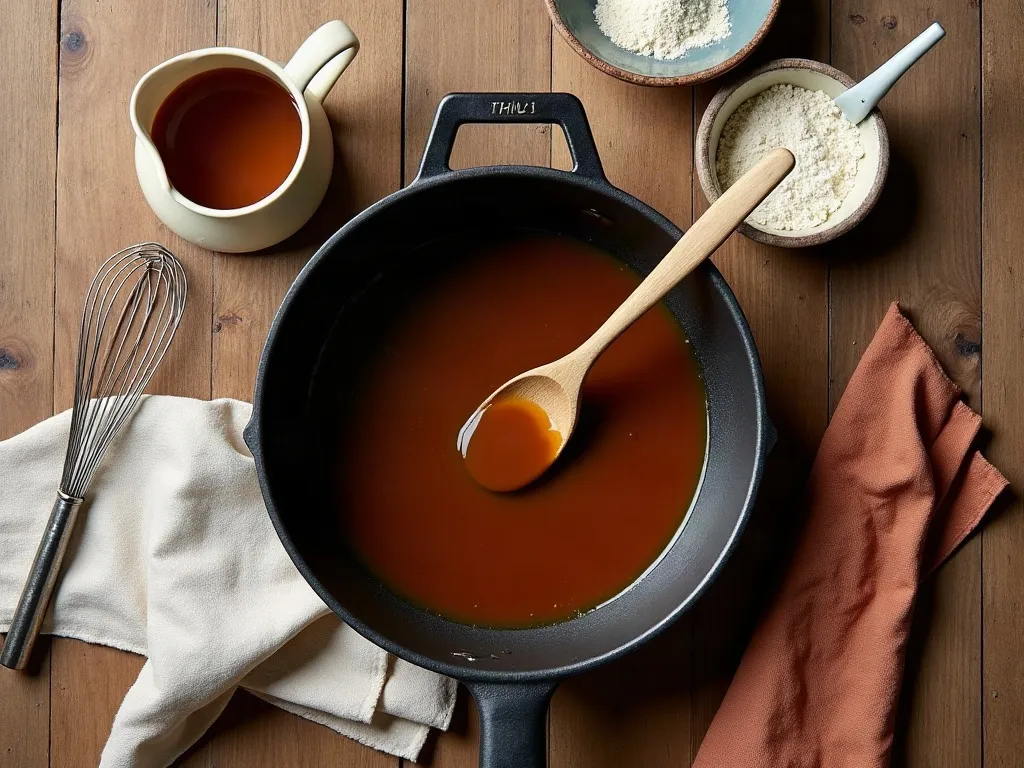
Most of what goes on a big table can be started when you decide to start it. Potatoes peel at eleven or at four. The bread goes in whenever there is a gap in the oven. Cranberry sauce is better for having been made on Monday, and nobody has ever complained that the carrots were roasted too early. Gravy is the one dish that cannot be moved, and not because it is difficult.
Its first ingredient is the roast, and the roast is not finished until it is finished. So gravy lands in the worst ten minutes of the day by construction: the meat is resting, the plates are out, somebody is asking whether they should sit down, and the oven is being turned up for whatever comes next. That is not a planning failure. It is a dependency.
The only dish made of another dish
Everything else on the menu arrives from the shop or the cupboard. Gravy arrives from the pan — the fond stuck across the bottom, the fat floating on top of it, the juice that runs out of the meat while it rests on the board. None of that exists at four o’clock.
Which is why a gravy made ahead is a different object. Stock and a thickener, cooked in a saucepan, is honest and useful, and the oven plan treats it as one of the things that can arrive already done, which it can. But it is the understudy. It tastes of stock because it is stock. The gravy that tastes of the roast has to be made in the pan the roast came out of, and there is no way to move that earlier than the roast allows.
So the pan is the recipe, and what happens in it is roughly three moves: lift what is stuck to the bottom, thicken, season.
Two thickeners, two doors
A pan of drippings can be thickened with flour cooked in fat, or with starch shaken into cold water. They enter at opposite ends of the process and they fail in opposite directions, and most gravy trouble is one of them being used like the other.
Flour in fat goes first. Pour off most of the fat and keep it close — some of it comes back — leave a couple of spoonfuls in the pan, set the pan over a moderate heat, and stir the flour into that fat before any liquid comes near it. Then give it a minute. That minute is the difference between a gravy that tastes of the roast and one that tastes faintly of paste. A lean roast gives up very little fat, so the fat often has to be added from the jug, or from the butter dish.
Starch and cold water goes last, into a pot that is already simmering. Shake it in a jar until no dry pockets are left, stir it through, and wait. Nothing will happen for a while, and then all of it will happen at once — which is how gravy ends up set like a pudding, because more went in while nothing was happening.
Both have the same failure at the front: dry flour meeting hot liquid. Flour dusted into a pan of hot stock does not whisk out. It sits in small pale lumps that stirring will not fix, and by then the pan is full and the meat is on the board. Flour meets fat, or flour meets cold water, and never flour meets hot stock.
Then judge the jug slightly loose. Gravy tightens as it stands, so what looks right at the stove is thick by the time it reaches the far end of the table. Thickening only goes one way. A thin gravy can take another spoonful; a thick one cannot be talked back down.
The salt was decided yesterday
Whatever was done to the meat is in the drippings. Salted the night before, brined, buttered under the skin, basted with something that had stock or soy in it — the seasoning was settled before the gravy existed. Stock adds the second half of it.
So taste out of the pan with a spoon before the salt cellar is opened at all, and taste again once the stock is in. What an undersalted gravy usually wants at the end is not salt but a splash of something sharp, or a little more stock to loosen it; what an oversalted one wants is more liquid than you planned to add, which is a decision better taken early than at the table.
Too little is a disaster, too much is Tuesday
The arithmetic here is lopsided in a way no other dish on the table shares. Running out is unrecoverable — somebody’s plate is dry and there is nothing to be done about it in front of them. Having a jug left over costs almost nothing, since the stock it is made of is the cheapest thing in the kitchen and the ten minutes were already spent.
So make more than the meal needs. It goes into the fridge as a jelly with a skin of fat across the top, which is its own lid, and it loosens again over a low heat in a small pan. A jug of gravy in the fridge is the difference between a week of dry meat and a week of dinners: on the mash, on the roots, on whatever the pan dinner left behind.
Stage the ten minutes
Because the work lands at a fixed and crowded moment, the only technique worth practising is having everything else already out when it arrives. Stock measured into a jug. Flour in a cup, with the fat it will meet. The whisk and a wooden spoon beside the hob. A warm jug to pour into. The carving board already on the counter. And the fat poured off the roasting pan as soon as the meat comes out — before it sets, and before anyone sits down — because that is the one minute you will not have later.
This is a different kind of late work from the one the last-hour notes describe. There, work is late because doing it early damages it: the crisp thing, the chopped herbs, the mash. Gravy is late because it cannot begin. The only part of it that moves is the staging, which is exactly why the staging deserves ten quiet minutes at four o’clock, before the kitchen gets loud.
It is not a holiday technique
The pan that fed you is the pan that makes the gravy, and that holds for a Sunday bird, for a braise, and for the archive’s BBQ cheese meatloaf, whose loaf pan gives a smaller pan with the same fond and a spoonful of fat in it. The scale changes and the operation does not. Learning it on an ordinary Tuesday, with a meatloaf and nobody waiting, is how it turns into a rhythm by the time a table is waiting.
Every other dish on the table is a decision. Gravy is a consequence of one you already took, and it will always be made at the end, by whoever is still standing. What can be done about that is small and worth doing: a jug of stock, a cup of flour, the fat poured off before anyone sits down, and enough of it that nobody has to ask for more.