
Lunchbox Notes for the Middle of Fall
By mid-October the packed lunch has lost its novelty. Practical notes on what travels well, how to keep cold things cold, and how the archive's prep style scales down to a lunchbox.
lunchboxmeal prepkid-friendly
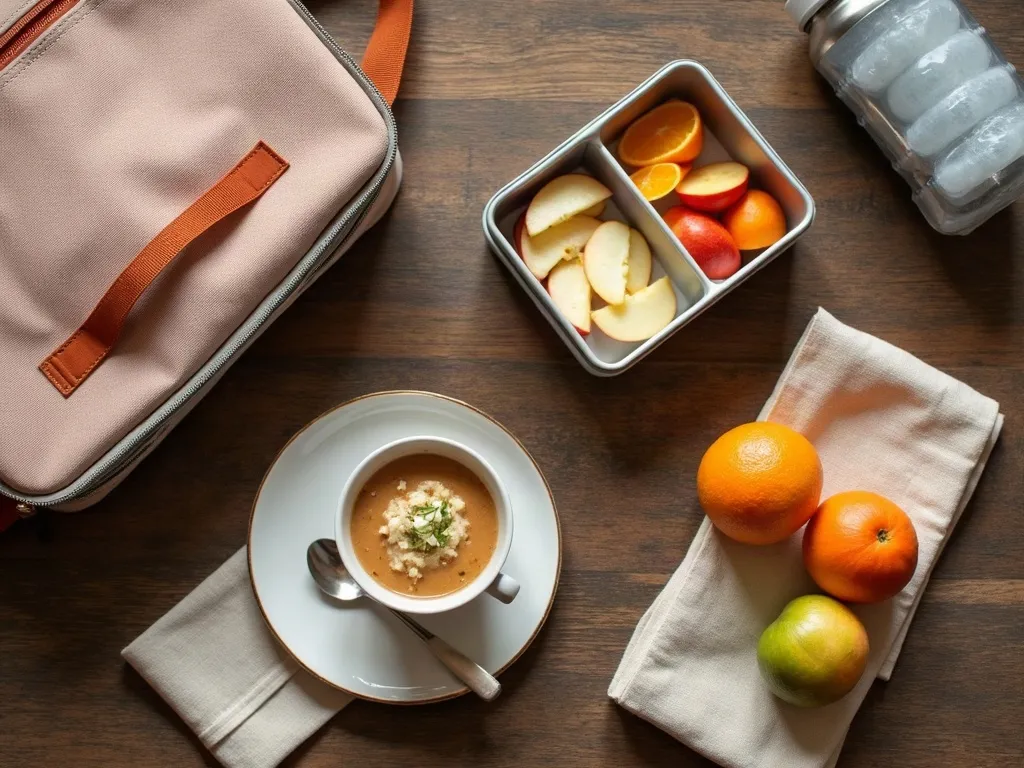
There is a week in October when the lunchbox quietly stops being fun. It doesn’t announce itself. The cut-out sandwiches just stop, the little notes stop, and somewhere around the seventh week of school the whole thing turns into a logistics problem. That’s the week worth planning for, because a lunch routine is much easier to keep going than it is to restart.
Lunch is a small engineering problem
The food has to survive a car ride, a backpack and a locker, and still be worth eating at noon. Some things manage that trip better than others, and the difference is rarely about the recipe.
Sandwich halves wrapped cut-side together hold their shape far better than a whole sandwich, and they’re easier for small hands to handle. Strips of cooked chicken travel well cold — the chicken fajitas from the archive are the obvious candidate, eaten as they are or tucked into a wrap. Apples and pears cut in the morning and given a squeeze of lemon brown noticeably more slowly than bare slices. Anything crisp stays crisp only if it’s packed separately and added at the last minute, which is why a small container of crackers and cucumber is worth the extra lid.
The one thing that never survives is a soggy bottom. Dressing, sauce and juicy fillings all belong in their own little jar, added at the table rather than in the bag.
Keep cold things cold, and hot things hot
Perishable food — sandwiches, cut fruit, yogurt, anything with meat or dairy — should stay chilled until lunchtime, and the standard guidance for a packed lunch is straightforward: a soft-sided insulated tote with two cold sources, such as a small frozen gel pack plus a frozen juice box that doubles as a drink and thaws by noon. A single gel pack is fine for a lunch eaten early in the day, but it isn’t meant to hold food cold for hours, so two is the safer habit on a long day.
Hot food has an old trick of its own, and it’s still the best one. Fill an insulated bottle with boiling water, let it stand for a few minutes to warm the walls, empty it, then fill it with piping hot food and keep it closed until lunch. Soup, chili and stewed leftovers all arrive hot enough to be worth eating.
Pack it the night before
If there’s one habit that separates a smooth lunchbox routine from a frazzled one, it’s packing the night before. Sandwiches made in the evening and kept in the refrigerator until morning taste no worse and take five minutes off a rushed start.
This is really just the archive’s prep style, scaled down. The component approach that works for weeknight dinners works for lunches too: cook a protein and a tray of vegetables once, keep a sauce in a jar, and let each morning be assembly rather than invention. When the week runs long and the refrigerator is empty, that’s what the freezer stash is for — a flat bag of chili or fajita strips thaws by lunchtime in an insulated bag, and Tuesday morning suddenly has a plan.
When it comes home full
Not every lunch gets eaten, and no system fixes that completely. What a good routine does is make the decent option the easy one — so on the busy mornings, when nobody has time to be creative, the lunch still gets made and still gets eaten. That’s the whole goal. Not a lunchbox anyone photographs, just one that comes home empty often enough to be worth the trouble.
Sources
- BAC to School: Pack a Safe Lunch 101fightbac.org