
Saturday Lunch Is Nobody's Job
A packed lunch is designed — it has a box, a time and a limit on what fits. Lunch at home has none of those, which is why it drifts to three o'clock and takes dinner down with it. Notes on giving the midday meal a shape.
kitchen notesexplainermeal prep
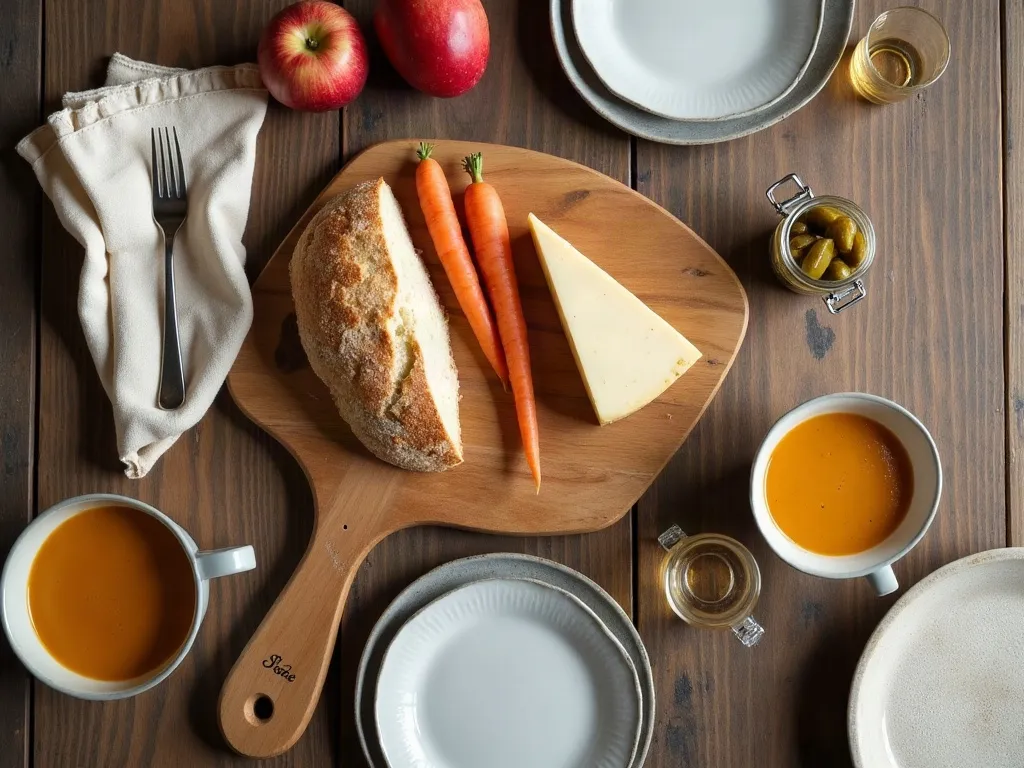
A weekday lunch is decided by someone else. There is a box, a time by which it has to be closed, a person who has to carry it, and a hard limit on what will fit inside. By the time it is eaten, the only decision left is the order. Saturday lunch has none of that — no box, no clock, no limit — and a kitchen that turned out five packed lunches without complaint can stand in front of a full refrigerator at noon and conclude, honestly, that there is nothing to eat.
That is not a failure of imagination, and it is not the cook being difficult. It is what happens to a meal when the constraints are taken away. The box was doing most of the work.
The box was the design
Think about what a packed lunch actually is: one container, one sitting, no second helpings, nothing that needs a hob, and a lid that has to close. Every one of those is a limit, and every limit is a decision made in advance. The container settles the amount. The journey settles the temperature. The person carrying it settles what is realistic. The packed-lunch notes call it a small engineering problem, which is exactly right — the engineering is what makes it possible at all.
Lunch at home has the opposite problem. Every option is present at once, and options do not add up to a meal; they cancel each other out. Bread, cheese, the cold end of a chicken, three jars, half a bag of something, a tin at the back of the shelf. A full refrigerator read as “nothing” is not the fridge’s fault. It is what a menu looks like when nobody has narrowed it.
Lunch needs a time before it needs a menu
Saturday mornings run late in most houses. Breakfast drifts to ten, nobody is hungry at twelve, and lunch gets postponed in favour of the next thing. Then at three o’clock somebody is eating standing up over the counter with the refrigerator door open, and dinner — the one meal of the weekend that does get planned — arrives at a table of people who ate an hour and a half ago and cannot say why they are not hungry.
The damage is not the sandwich at three. It is that dinner was spent on it.
So the decision that matters at midday is not what to eat but when. Noon is a sensible default in a house that eats at six, because the gap is what makes the evening work; one o’clock is fine too, as long as it was chosen. Two sittings are also fine — the small ones at twelve, everyone else at two — provided the sittings were decided rather than discovered. The thing to avoid is leaving lunch to the kitchen’s default, which is three.
There is a second half to that decision, and it is the one that actually protects the day: dinner is the meal that has to survive. If lunch runs to two o’clock, dinner is later or lighter. Better to know that at two than at half past five, when the only remaining option is to cook something and hope.
Assemble rather than cook
The home version of lunch is a board, not a recipe. Four things, roughly:
- something starchy — a slice of bread, the end of a loaf, cold rice, a potato from yesterday
- something cold and substantial — cheese, the cold meat off the bird, a boiled egg
- something sharp — a pickle, mustard, the jar of something in brine that nobody remembers opening
- something raw and crisp — a carrot, an apple, a handful of leaves that need using
That is a plate, and it takes as long to put together as it does to slice a loaf. Read the list as a way of looking rather than a formula to follow: four columns, and the refrigerator becomes a lookup table instead of a problem. The difference from the lunch that goes to work is instructive. That bag is designed around a journey — two temperatures, a container that survives being carried, food that holds for the hours between a kitchen and a desk. Take the journey away and the design goes with it, which is why the same lunch that works at a desk so rarely gets made at home.
One hot thing is enough
If the day wants something warm — and by mid-November it usually does — one pot is the limit. A portion of soup out of the freezer, warmed in a small pan. Or eggs, which need a pan and nothing else. Or the other half of last night’s something, brought back in the pan it came out of. The point here is only the count.
Two hot things means two pans, and two pans means a wash-up in the middle of the afternoon. The middle of the afternoon is when the day is supposed to be free, and a kitchen that was clean at eleven and is dirty at three is a worse trade on a Saturday than on a Tuesday, because on Saturday nobody has the excuse of having been at work.
The job can be handed over
Because a board is assembly rather than cooking, it is work that someone else can genuinely do. Not the decorative kind of help that ends with an adult finishing it — the actual job. A child who can slice cheese and open a jar can build a board, if the components are already out and the knife is the one thing that stays with an adult. The distinction between help that is real and help that is theatre is its own piece, and lunch is the meal where it is easiest to get right: the output is visible, it gets eaten immediately, and nobody has to be told that it was useful.
There is a practical side effect worth naming. A board built by the person eating it is a board built in the amount that person will actually eat, which removes the whole argument that starts with a full plate and ends with a bin.
What the weekend is actually for
The odd thing about the weekend lunch is that it is the only meal in the week with no owner. A packed lunch belongs to whoever packs it and whoever carries it. Dinner belongs to whoever is cooking. Breakfast belongs to whoever is up first. Lunch at home on a Saturday belongs to no one, and a meal with no owner does not turn into a feast — it turns into a series of snacks, eaten at intervals, none of them remembered.
Give it a time and a board and it becomes the easiest meal of the week: no recipe, no pan, nothing that can go wrong, and dinner arriving with an appetite behind it. That is a small piece of design for a meal that never had any. The box was never the point. The shape was.