
The Lunch That Goes to Work
Packing for a school backpack is one problem; packing for your own desk is another. Notes on jars, cold packs, and the ten minutes that make a weekday lunch worth eating.
lunchboxmeal prepkitchen notes
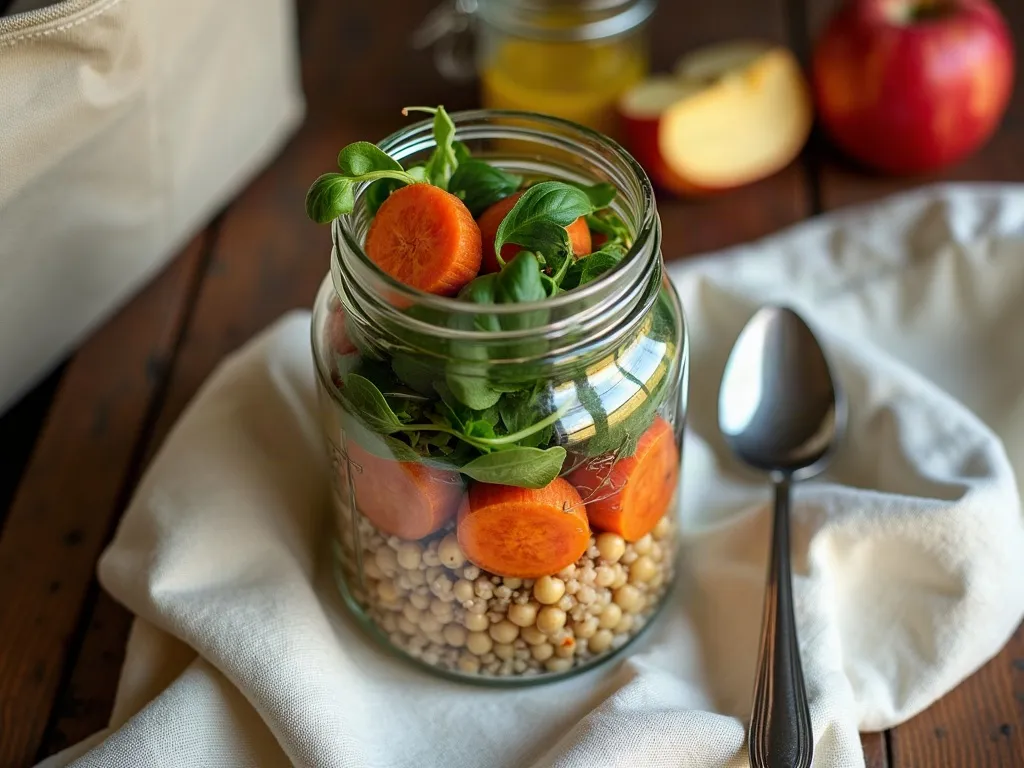
The school lunchbox gets all the attention, and it deserves it — a lunch packed for a nine-year-old has to survive a backpack, a coat hook and a rushed ten minutes at a noisy table. We wrote about that problem earlier this month. But there is another lunch in most houses, packed later and with less thought, usually at eleven at night, usually by the person who has been feeding everyone else: the one that goes to work.
It fails for a different reason. It is rarely a matter of not knowing what to pack. It is that a workday lunch is eaten away from a stove, sometimes away from a table, often while answering something. The food has to be good cold or reheat cleanly, it has to make it through a commute, and it has to still look like something you want at half past twelve. That is a packaging problem as much as a cooking one, and it is solvable in about ten minutes if you solve it in the right order.
The commute decides more than the menu
A lunch carried in a bag gets shaken, tipped and leaned on. Which is why the container that works is the one that closes with threads, not the one that closes with a rubber flap. A wide-mouth glass jar — the kind that holds a quart — will take soup, grain salad, leftover chili or yogurt with fruit, seal hard, and rinse clean in a sink at the office. Clip-lid glass boxes are lovely on a shelf and terrible in a backpack, because the lid is the first thing that gets pushed.
The second decision is that wet and dry travel separately. Dressing, a wedge of lemon, a spoonful of yogurt sauce: all of it goes in its own small jar. A dressed salad at seven in the morning is a wilted salad at noon, and no amount of good intention fixes that. Undressed, the same lunch arrives crisp.
A drawer is part of the kitchen
The most useful thing in a workday lunch setup is not in the fridge. It is a small drawer or a tin in a desk: salt, a pepper grinder if you are serious about it, a metal fork and spoon, a few napkins, tea, and a tiny bottle each of olive oil and vinegar. None of it is expensive and all of it means the lunch does not have to be fully seasoned before it leaves the house. It also means a plain container of grains and roasted vegetables can be made good at the desk with thirty seconds of work, which is roughly the amount of patience available at midday.
This is the same logic as the component prep we keep coming back to, just pointed at one person instead of a family: cook a pot of something, roast a tray of vegetables, keep a sauce in the fridge, and assemble the day’s jar in the morning from what is already there. The jar does not need a recipe. It needs a base, a vegetable, something with protein in it, and a sharp thing on top.
Two temperatures in one bag
The trickiest part of a work lunch is that it is usually half refrigerator food and half nothing of the kind. Roast vegetables, grains, beans, cold chicken, hard cheese and fruit all travel well when the bag stays cold. A freezer pack in an insulated bag does that job, and if the office has a refrigerator, the bag only has to survive the journey.
Where the day goes wrong is the gap: a bag left in a warm car, a lunch sitting on a desk from nine until one. Perishable food that has been cooked or cut should not sit at room temperature for more than about two hours — the guidance is a good deal shorter in genuinely hot weather — so the sensible habit is that anything perishable either stays cold in the bag until it is eaten, or goes into the office refrigerator when you arrive, before you sit down and start answering things. Our chicken fajitas are a good example of a dish that handles both routes: hot from a skillet at home, decent cold from a bag the next day.
The Friday rule
Office refrigerators run on a different law than the one at home. Things go in, things stop being anyone’s, and by Friday there is a shelf of containers nobody will claim. Two habits keep that from happening to your good jars: write the day on the lid in marker before it goes in, and take the empty container home the same afternoon it was emptied. A jar that spends the weekend in a shared fridge comes back needing to be thrown away, and then the good container is gone and the next week’s lunch is packed in something worse.
The afternoon is a separate problem
The vending machine wins at three o’clock because it is the only thing that was planned for three o’clock. If a second, smaller thing goes into the bag in the morning — an apple, a small container of nuts, yogurt, a square of the apple quick bread from the weekend — then the decision has already been made by someone with more patience than the afternoon version of you.
The rule we would keep from the school lunchbox is the same one, only the audience changed. Pack what you would actually want to eat at half past twelve, not what you think you should be eating. A lunch you look forward to gets eaten; a lunch you packed as a resolution gets abandoned by Tuesday, and then it is a nine-dollar sandwich and a vague sense of having failed at something that was never really about willpower.