
Not Every Green Tomato Is Waiting
The first week of November brings the plants in and a tray of fruit that never finished. The sorting is the whole job: what gets to colour, what is better cooked green, and what ends up as a bag of sauce.
seasonal producefall cookingkitchen notesfreezer meals
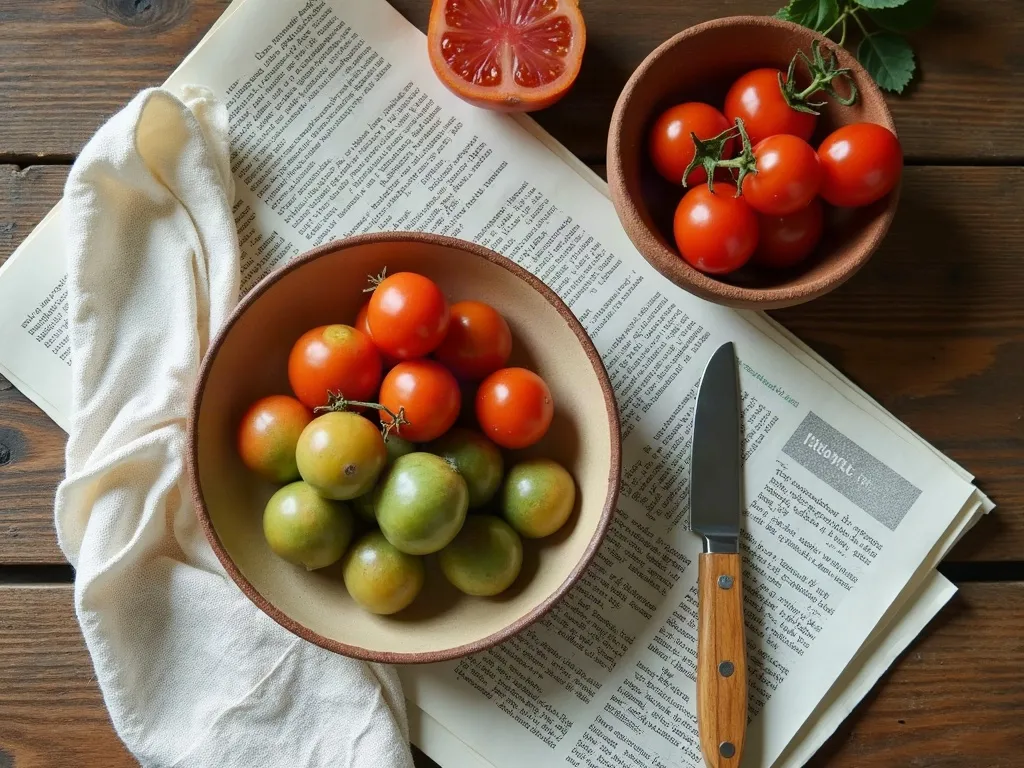
By the first week of November the tomato plants are mostly stems. Whatever fruit is still hanging is hard, cold to the touch in the morning, and it comes into the kitchen in a basket along with the stakes and the string. The same basket turns up from the market, where the last flats of the season go cheap and green because green is what is left.
The instinct is to treat that basket as a rescue operation — get everything to ripen, waste nothing. A smaller framing works better. The tray on the counter is the last fresh tomatoes of the year, and the only question worth asking is which ones you want to eat sliced on a plate and which ones you would rather have as sauce. Those are two different jobs with two different endings, and deciding once, the day the basket arrives, is what keeps the tray from turning into something you check guiltily and never quite finish.
A blush is not the same as hard green
A tomato that has begun to turn — a blush at the blossom end, a shoulder gone from dark to pale — has already started. It will finish on a counter in the ordinary way, and when you cut it, it will taste like a tomato and not like the inside of a refrigerator.
A tomato that is uniformly dark, hard and heavy has not started, and it is not going to catch up. It sits there getting softer while the colour never arrives, and by the time you give up on it, the texture that made it worth waiting for is gone. That is the one to cook. The basket sorts by how far along each fruit is, not by size and not by variety: the blushed ones to the tray, the hard ones to the board, and anything split or leaking straight into the pan because it will not wait for a plan.
The tray
Single layer, not a heap. Newspaper or an old towel on a tray, the fruit spaced so the shoulders are not pressed against each other, laid so that nothing rests on the stem scar. In the coolest room in the house that is not the refrigerator — a cold tomato goes mealy, and mealy is the one thing the tray exists to avoid — and out of direct sun, since sun on a soft spot is how one bad fruit takes the row beside it with it.
Then leave it alone and check it every few days. Take off what has coloured instead of waiting for the whole tray to finish; the ones that ripen first are the ones to eat that night, sliced with salt, and the tray keeps working without being managed. If the room is bright, a second sheet of newspaper over the top does the same job as moving the tray to a darker corner.
The board
Fried green tomatoes are the reason not to ripen everything. Slice them a little under half an inch thick, salt both sides, and let them sit on a rack for a few minutes while the pan heats — the salt pulls the water out, and dry slices are the difference between a crust and a coating that slides off. Cornmeal with a spoonful of flour, a generous film of oil in a heavy pan, medium heat, and no crowding; a second batch is faster than a soggy first one.
The rest of the hard pile can go a slower way. A green tomato chutney — onion, cider vinegar, brown sugar, mustard seed, simmered low until it is jammy — is the sort of thing that earns its shelf space in the refrigerator door, and it does the relish job beside the archive’s BBQ cheese meatloaf better than a sweet pickle does.
Roasting is the third answer, and the least fussy: halves, oil, salt, a pinch of sugar, a hot oven until the cut edges char and the flesh collapses. Green tomatoes roasted this way lose the sourness that puts people off and keep a little bite, which is exactly what a sauce wants.
What the tray was always for
When the tray stops producing colour, the last stubborn fruit goes on the same sheet pan as a couple of onions and a head of garlic, and the whole thing becomes sauce. Push it through a sieve or leave it rough, taste it for salt, and put it in a flat bag in the freezer that has been getting emptied out all autumn — one bag, one meal’s worth, labelled in the same handwriting as everything else in there.
That sauce is not a consolation prize. It is the fresh version of the canned tomatoes the archive leans on: the baked chicken parm from 2010 asks for a cup and a half of crushed tomatoes, and a loose jar of this does the same work with more acid and more sweetness at the edges. If the tray is going to end in a bag anyway, it is worth buying one more flat than the household can eat fresh — that flat is the winter’s pasta, and it costs less in November than it will in any other month.
Then the newspaper rolls up and goes out with the stems, the window gets its light back, and the kitchen moves on to the drawer of roots, which is where dinner lives from here until the holidays.
The tray is not a preservation project. It is a couple of weeks of tomatoes, honestly sorted, and the trick is only to sort them on the day they come in rather than the day they have gone soft.