
Chard Comes in Two Vegetables
The ribs and the leaves want opposite things from a pan, and most greens that disappoint at home are a timing problem rather than a seasoning one. Notes on splitting a November bunch.
seasonal producefall cookingweeknight dinnersexplainer
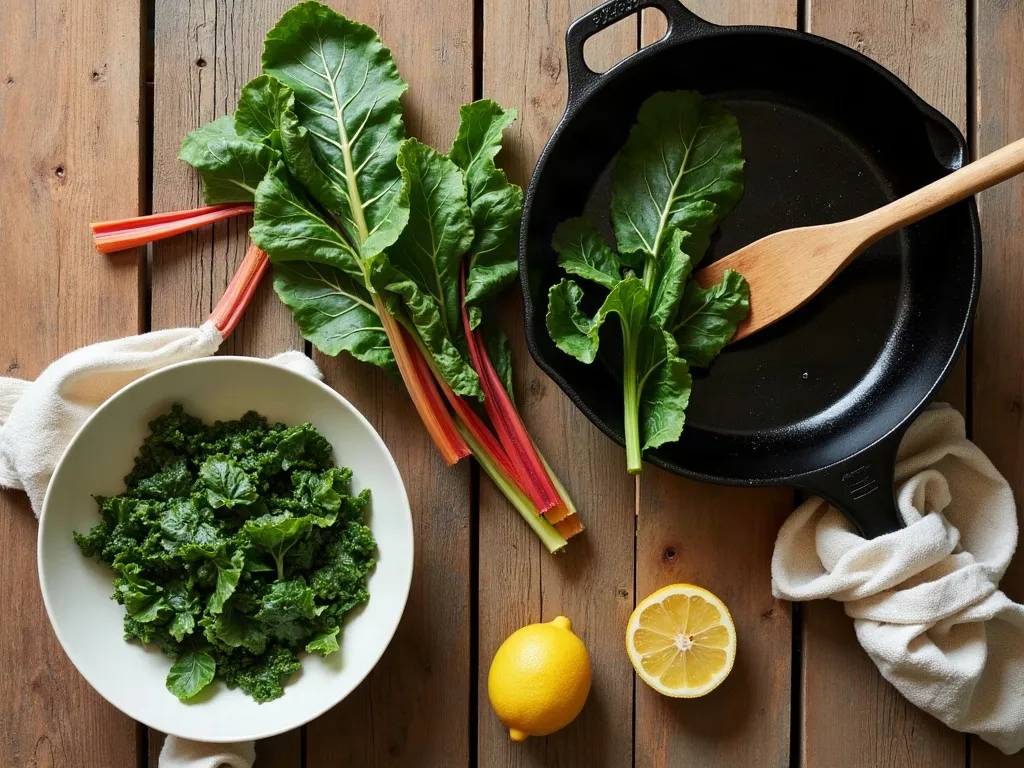
The chard at the market this week stood in a bucket of water, bunched and tied, ribs as thick as a thumb and leaves the size of a plate. It looked like a vegetable for a household of six. It went into the pan and came out as a side dish for three, which is the first thing to know about a bunch of greens and the least surprising.
The second thing is the one that decides whether the dish is any good. A bunch of chard is not one vegetable. It is two, dressed in the same colours, and they want opposite things from a pan.
Two clocks in one bunch
The rib is water held in structure. It wants time — long enough to go from rigid to bendable, long enough to pick up a little colour at the cut edges — and it will hold its shape through all of it. The leaf is a different material entirely. It collapses on contact, gives up its volume inside a minute, and slides from bright to olive in the next one.
Cook them together and there is no good outcome. Lift the pan when the stems are ready and the leaves have been finished for a while: soft, dark, and tasting mostly of the water they let go. Lift it when the leaves are ready and the stems are still stringy enough to need a knife. Greens that disappoint at home are rarely badly seasoned. They are cooked on one clock.
The split takes a minute
Nothing about this needs a gadget. Hold a stem in one hand, fold the leaf over the back of it, and pull the leaf away in one motion; the big ribs come off in a single strip. Smaller ones want a knife run down either side, close to the stem.
Washing belongs in the same minute, because grit on chard and beet greens collects in the crease where the rib meets the leaf, and once the bunch is in a colander no amount of running water gets it out. Cut the bottom inch off, drop the bunch in a bowl of cold water, swish it, then lift it out rather than tipping the bowl. Whatever settles at the bottom is sand, not stock. The leaves go into a towel, the ribs onto the board, sliced thin on the bias so they have edges to soften against.
The order in the pan
A wide pan rather than a deep pot. Leaves need surface, and a crowded pan steams everything in it. Fat first, then whatever the drawer offers — an onion, garlic, a dried chile — and then the sliced ribs, salted now instead of later, because they can take it and the leaves cannot yet.
The stems get the long part of the evening: several minutes, until they bend without arguing and the cut edges have gone gold. If the pan is browning faster than the stems are softening, a splash of water and a lid will even them out; take the lid off again before the leaves go in, or the whole thing finishes as a steam.
Then the leaves, in handfuls, with only the water still clinging to them. They will look like far too much for the pan for about a minute, and then they won’t. This is the moment people step away to deal with something else, and it is the moment the colour goes. Stay at the stove. Salt the leaves at the end rather than the start, because salt draws water and water is what turns a fry into a boil.
Acid last, off the heat or nearly: half a lemon, a vinegar, the brine from a jar of something. Greens take more of it than most vegetables and taste oddly flat without it.
What the stems are for
The ribs are not the price of the leaves. Given the first minutes and a hot pan, they are the part of the dish that still has texture in it, and the part that carries a hard sear, chile, garlic, a spoonful of something sweet — the same way beet greens behave, being the same family, as the root drawer notes point out when the tops come home with the beets.
Two other places they earn their keep. The stock bag in the freezer, where the trimmed bottoms and any ribs too woody to bother with go in with the parmesan rind and the onion ends. And the bean pot, where a handful of sliced stems can go in with the beans while the leaves wait for the last five minutes — a pot of beans is assembly for the rest of the week, and greens are one of the things it assembles with.
Smaller than it looks
Which brings back the bucket. A big bunch of chard cooks down to a dish that serves two, maybe three, next to something else, and the pan that looked overfull at the start is the honest measure of it. Chard is not a side dish that fills a plate the way potatoes do. It is the thing that turns a bowl of beans, a baked potato, or the end of a roast into dinner, and it is worth buying two bunches when the market still has them — one for tonight, one for the night in the week when there is nothing green left in the refrigerator and the alternative is a bag of something frozen.
The dish is right when it looks glossy rather than wet, dark green with the ribs still holding their shape and a little bite, and it takes about as long to cook as it took to read this. The stems go in first. Everything that follows from that is detail.