
A Pot of Beans Is Not a Recipe
Dried beans are the one pantry staple where the cooking is the prep itself: an hour at the stove that turns into three weeknight dinners and a stack of flat freezer bags.
meal prepweeknight dinnersfreezer mealsfall cooking
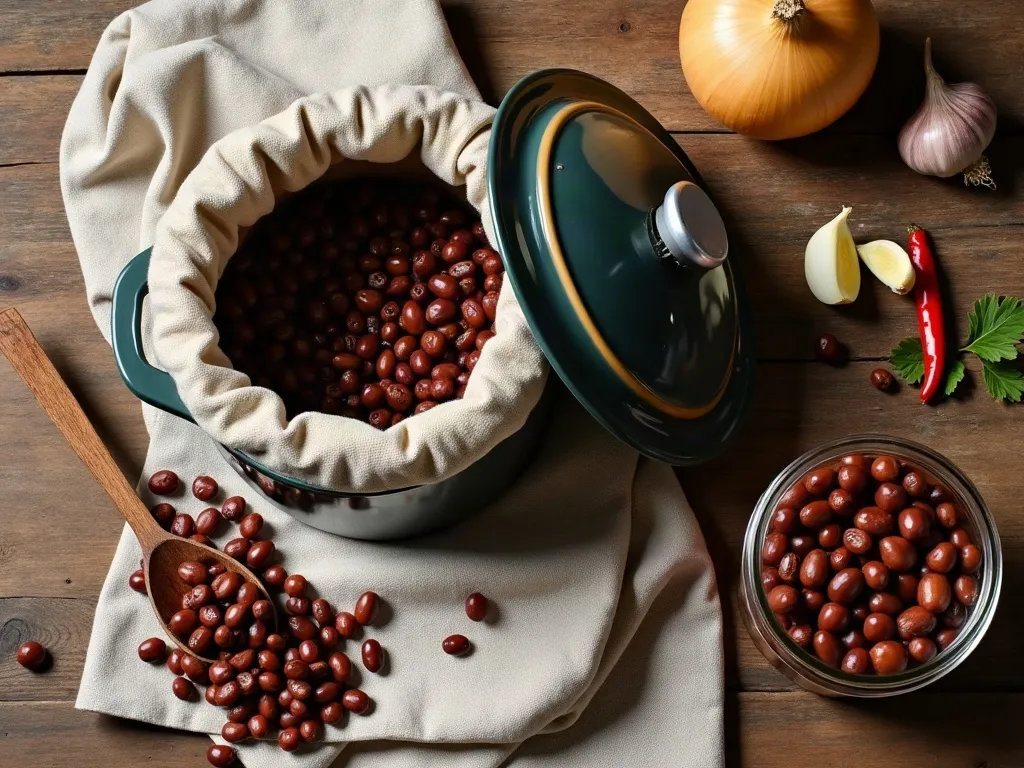
There is a bag of dried beans in most kitchens, and it has been there a while. It came in with good intentions — a chili that never got made, a vague plan about the grocery bill — and then it went behind the rice. We know, because ours did too.
The useful thing to say about dried beans is that they are not a recipe. There is no method to learn, no step that fails the first three attempts. There is a pot, some water, an hour you were going to spend in the house anyway, and a cue you can read off a spoon. What comes out isn’t a dish so much as an ingredient: a container of beans and a container of the liquid they cooked in, and between the two of them dinner is mostly assembly for the rest of the week.
What the pot needs
A heavy pot with a lid, because a thin one scorches at the bottom before the middle is tender. Water to cover by a couple of inches — more than looks right, since the beans drink it and you want what’s left. An onion, halved and left in big pieces so it can be fished out later. Two or three garlic cloves, a bay leaf, and if there’s one in the drawer, a dried chile, which gives the pot a low background warmth without making it hot.
Soaking is optional, and we’ve stopped pretending otherwise. A bag soaked overnight cooks faster and more evenly. A bag that goes straight from the shelf into the pot takes longer and needs topping up. Both work; the choice is about your afternoon, not about the beans. On a Sunday, with the pot running in the background, we don’t soak. On a weeknight we do, because ninety minutes and two and a half hours are different evenings.
Bring it to a boil, then turn it down until the surface is barely moving. A rolling boil breaks skins, foams against the lid and leaves the stovetop ringed with starch. The bare simmer is the entire technique.
Salt goes in at the start. That’s house practice rather than something we’d argue about in the street: the beans end up seasoned through rather than salty on the outside, and the liquid is worth keeping. What we do hold back is anything sour — tomatoes, vinegar, a squeeze of lemon — until the beans are already tender, because in our experience the pot slows to a crawl once the acid is in. Add it at the end, off the heat or close to it.
The cue, not the clock
Recipes give times and the times are a guess. This year’s beans are drier than last year’s, and a bag that has stood open since spring takes considerably longer than one from Saturday’s shop. So we don’t time it. We blow on a spoonful and taste. Tender is when the skin curls back and the middle gives under a finger without collapsing into paste. Chalky in the centre means another fifteen minutes and another taste. That’s the whole method: taste, wait, taste.
Fish the aromatics out when the beans are done, and salt again if the liquid tastes flat.
Three dinners, and the liquid counts as one
The beans go into the refrigerator in their liquid, which is the part that usually goes down the sink. That liquid is why a pot of beans is a week of dinners instead of one: it’s a soup base with the body already built in.
First, a bowl of beans with the cooking liquid loosened with a little water and finished with whatever the drawer has — a spoon of tomato paste, the end of a bunch of greens, oil at the table. The soup-season notes make the point that the body is the hard part of a pot of soup; here the body is what you already have.
Second, beans over rice or over roasted vegetables, liquid spooned on, something sharp on top. This one travels well. A jar of it, packed the night before with a small jar of dressing beside it, is the lunch that goes to work on a day with no microwave in sight.
Third, a smaller amount of chili. The archive’s 2011 paleo chili is deliberately bean-free, which is an honest thing to notice about a recipe written for a legume-free way of eating; a cup of beans stirred into the pot makes it feed more people without changing what it is. The same spoonful improves a tray of pan-dinner leftovers.
The freezer half
Cool whatever you won’t eat inside a few days, and cool it quickly: divide it into shallow containers instead of leaving a deep pot on the counter. The USDA guidance that Fight BAC! restates is to refrigerate cooked food within about two hours and eat leftovers within three to four days, and the same page makes the shallow-container point directly.
Cooked beans freeze well in their liquid. We portion them two cups at a time into zip bags, press the bags flat on a sheet pan, and file them upright in the crate — the same tape-and-marker habit as everything else in there, because a flat bag of brown beans looks exactly like every other flat bag of brown beans.
A note on the can
None of this is an argument against canned beans. We keep them, and on a Tuesday with no pot in the fridge they are the reason dinner happens at all. What the dried bag buys is quantity and liquid at once, from one bag that costs less than the dinners it replaces. Not virtue — arithmetic, plus an hour you can spend folding laundry while the pot does the work.