
Home Hyperbaric Chamber vs Clinic Sessions: We Ran the Household Numbers
A family-budget look at paying per session at a clinic versus owning a soft-shell or hard-shell chamber: cost table, break-even, drive time, floor space, power, noise and the HSA/FSA fine print.
household budgetexplainerhome notes

A reader wrote in this month with a question we have heard in some form from three different households now. One parent goes to a wellness center for hyperbaric sessions twice a week. The other is thinking about starting. Somebody at the front desk mentioned that “a lot of families just buy one,” and now there is a browser tab open on the kitchen laptop with a five-figure price on it.
We are a kitchen site, and we are not going to tell anyone whether hyperbaric sessions are worth doing. That is a conversation for a physician. What we can do is the part we do for every big household purchase, from a chest freezer to a second car: write down what it really costs, what it takes from the week, and where in the house it would actually go.
So we sat down with a notebook, the family calendar and a calculator, and ran it.
First, what is being compared
Two kinds of home chamber show up in every search.
Soft-shell chambers are inflatable fabric capsules, usually limited to mild pressures of around 1.3 to 1.5 ATA. They are lighter, they can be set up by the owner, and they sit at the low end of the price range.
Hard-shell chambers are rigid pressure vessels, typically rated to 2.0 ATA, delivered and installed by the seller, and priced like a vehicle rather than an appliance. Some seat one person, some seat two or four.
The market has plenty of names in it. You will see OxyHealth, Summit to Sea, Newtowne Hyperbarics, CHAMBERS by Fortius and others, and prices and inclusions vary enough that we would not trust anybody’s summary, ours included, over a written quote. For the arithmetic below we used one manufacturer’s published list prices because they cover both shell types and spell out what is included: Superhuman lists a soft-shell S1 at 1.5 ATA from $14,900, a one-person hard-shell L1 at 2.0 ATA from $49,900, and a two-seat hard-shell T2 from $99,900. Swap in any quote you have; the method is the same.
One honest caveat before the numbers. A clinic session and a home session are not always the same product. A hospital hyperbaric department treating one of the conditions on the UHMS indications list works under a physician’s order, often at higher pressure, and is often billed to insurance. Nothing on this page replaces that. What we are comparing is the cash-pay wellness visit against owning a chamber for the same kind of routine use.
The assumptions, out loud
Every one of these is a placeholder; change any of them and the answer moves.
- Clinic price: $150 per session, cash. Prices vary a lot by city and pressure.
- Frequency: two sessions a week, 48 weeks a year, so 96 sessions per person per year.
- Soft-shell extras: about $500 shipping (quoted separately for the S1), and about $300 a year for filters, masks and small parts.
- Hard-shell extras: about $1,000 for room prep and an electrician’s visit, even where delivery and installation are included in the price. Running costs of $600 a year for a one-seat unit and $800 for a two-seat.
- Electricity: small enough to ignore at this level.
- Resale: left out of the break-even entirely. We cannot predict what a used unit fetches in five years, so treat it as a bonus.
The table
| Option | Up front (assumed) | Running cost / year | Cost per session, 3 years, 1 user | Break-even vs clinic |
|---|---|---|---|---|
| Clinic, $150 per visit | $0 | $14,400 per user | $150 | n/a |
| Soft-shell, 1 seat (S1 list price) | $15,400 | $300 | about $57 | about 105 sessions: 13 months for one user, 6.5 months for two |
| Hard-shell, 1 seat (L1 list price) | $50,900 | $600 | about $183 | about 355 sessions: 3.7 years for one user, 1.8 years for two |
| Hard-shell, 2 seats (T2 list price) | $100,900 | $800 | n/a (built for two at once) | about 345 shared sessions, so roughly 3.6 years for a couple going together |
How we got the break-even: up-front cost divided by what each session saves, which is the $150 clinic fee minus the small running cost per session. For the two-seat chamber, a shared session replaces two clinic visits, so it saves about $290 each time.
If the clinic sells packages
Almost nobody pays the walk-in rate for long. Ten-packs and monthly memberships are common, and they move the break-even a long way. Here is the same math with the clinic at an effective $100 a session:
| Option | Break-even at $100 per clinic session |
|---|---|
| Soft-shell, 1 seat | about 160 sessions: 20 months for one user, 10 months for two |
| Hard-shell, 1 seat | about 545 sessions: 5.7 years for one user, 2.8 years for two |
| Hard-shell, 2 seats | about 525 shared sessions: 5.5 years for a couple |
Also check what the clinic session actually is. A wellness center running soft-shell sessions at mild pressure is the fair comparison for a soft-shell at home. A 2.0 ATA hard-shell session is the fair comparison for a hard-shell. Comparing a cheap soft-shell at home against an expensive hard-shell clinic visit flatters the purchase.
Three things jump off that table.
The soft-shell pays for itself fast if someone is genuinely going twice a week. Inside about a year, on these numbers, even with only one person using it.
The one-seat hard-shell is a multi-year decision for a single user. With two adults taking turns, it starts to look more like the soft-shell math, provided both of them keep going. That proviso is doing a lot of work.
The two-seat unit only makes sense if two people actually sit in it together on a schedule. Bought for one person “and maybe the other one later,” it is the most expensive line on the page by a distance.
The number that is not in the table: time

A one-hour clinic session, for a family living twenty-five minutes away, took about two and a quarter hours door to door once we added parking, check-in, the session itself and the drive home. Twice a week, that is four and a half hours, which in a house with school pickup is the same as saying it will not happen on Thursdays.
At home the same session is roughly an hour and a quarter including setup and wipe-down, and it can start at 8:45 at night after the dishwasher is loaded. That flexibility is the strongest argument for owning, and it is also the most dangerous one, because “I can do it any time” turns into “I’ll do it tomorrow” very easily. A chamber that gets used once a fortnight never reaches its break-even. Before buying, we would book the clinic for a solid two months and look honestly at how many sessions actually happened.
Renting before buying
There is a middle option that most cost pages skip: renting. When we checked in October 2026, Affordable Hyperbaric Solutions listed monthly soft-shell rentals starting at $899 a month for a small chamber, $1,049 for a mid-size and $1,199 for a large one, each with a 10-liter oxygen concentrator and with shipping quoted separately.
At eight sessions a month, $899 works out to about $112 a session, which is no bargain against a clinic package. At sixteen sessions a month, with two adults using it, it is about $56. The real value of a month or two of rental is information. You find out whether sessions actually happen at 8:45 p.m., whether the compressor bothers anyone, and whether lying in an enclosed space suits you; Mayo Clinic notes that some people feel anxiety in the chamber, and ear pressure is the most common complaint. Ask up front whether any rental fees count toward a purchase, and get the answer in writing.
Where it would actually go
We walked through the three rooms that people mention.
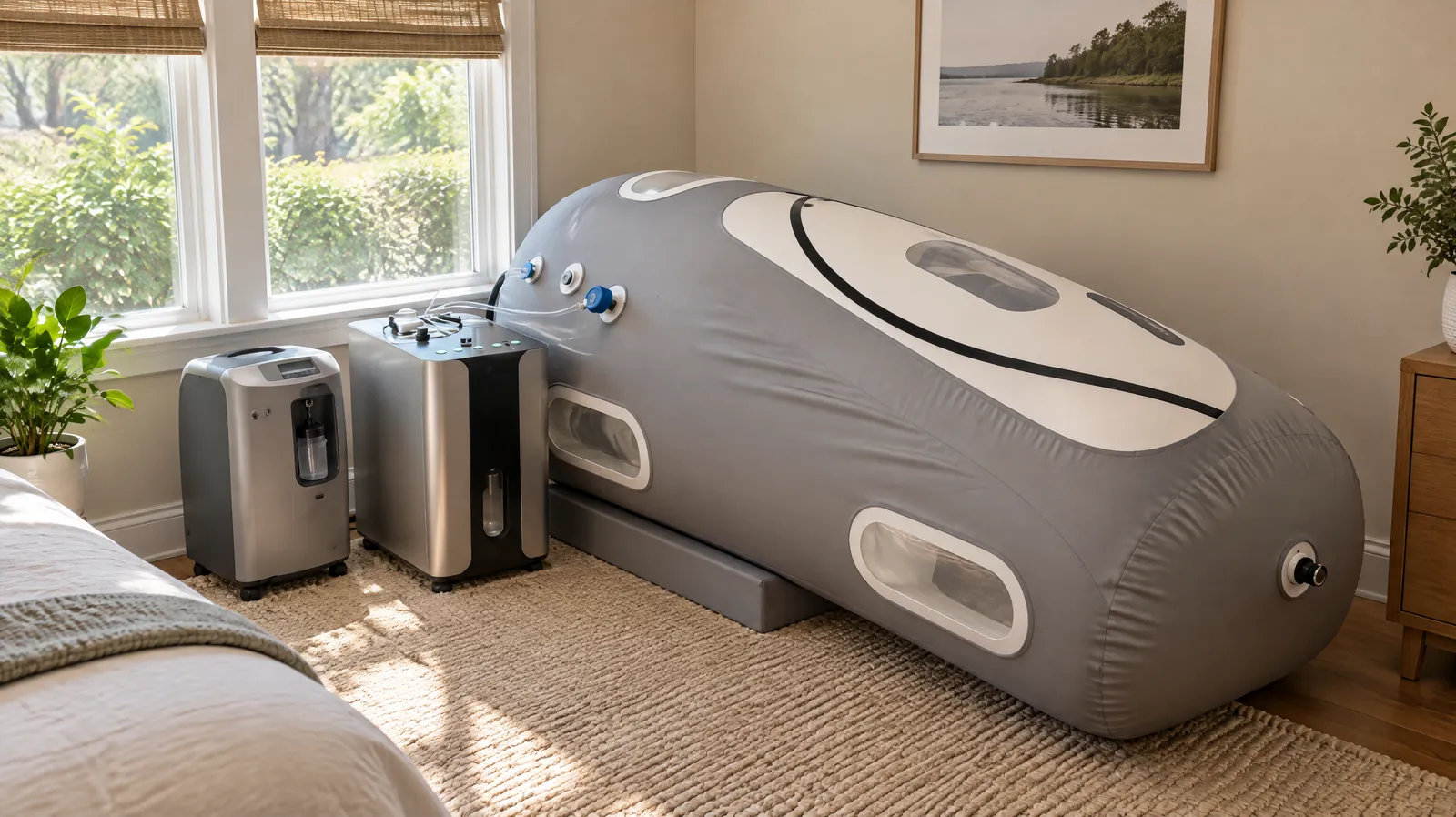
The spare room is the easy answer for a soft-shell. The S1 capsule weighs 29 pounds and is under six feet long, so it fits where a daybed would, and it folds away. The compressor and concentrator need a spot nearby and some airflow around them.
The garage sounds ideal until you think about January and August. Manufacturers check ventilation and climate for a reason: equipment and people both need a sane room temperature, and a garage that is 40 degrees at 7 a.m. is not a pleasant place to sit for an hour.
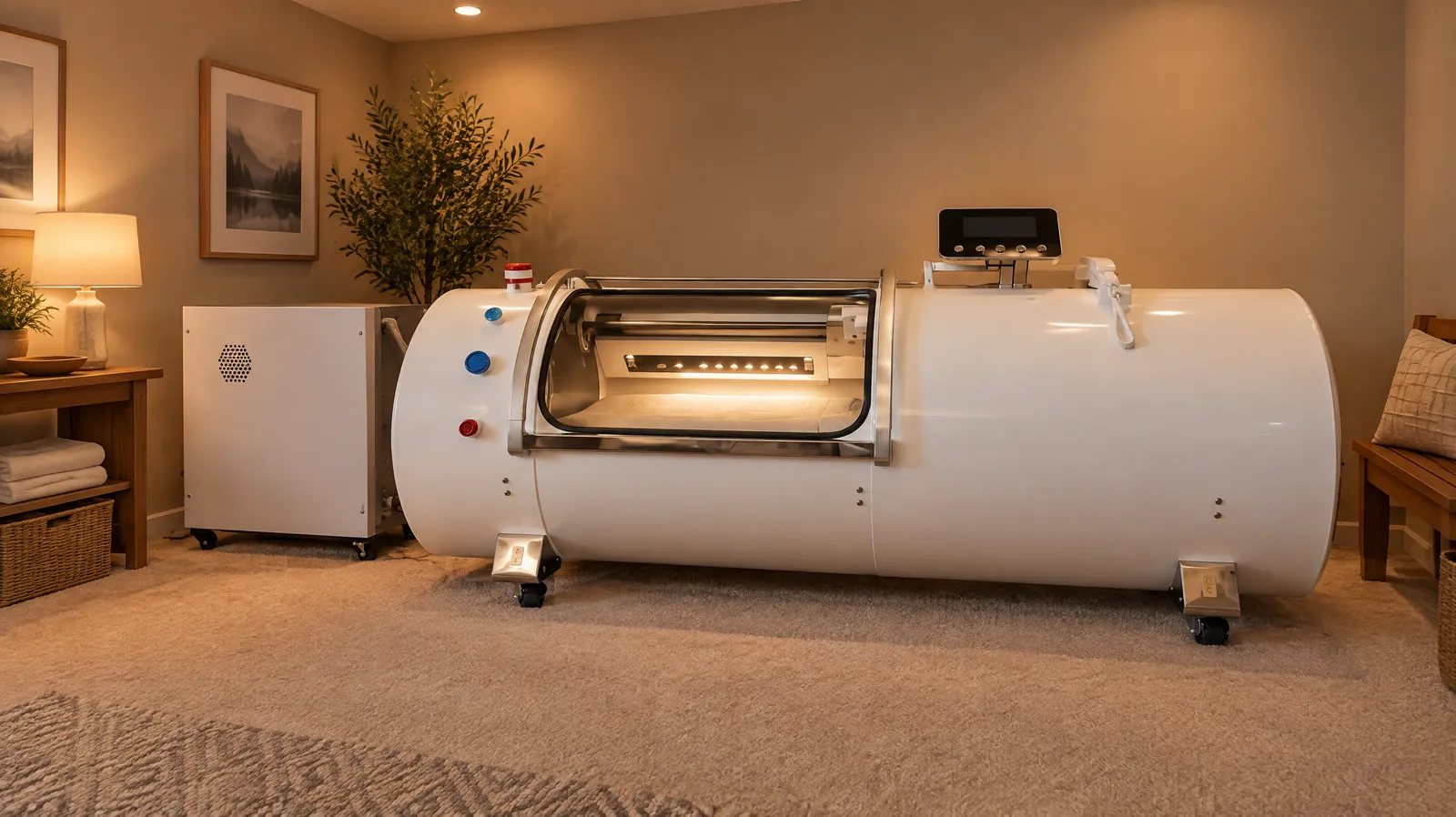
The basement is the obvious place for a hard-shell, and it raises the most questions. A steel vessel is heavy, and the question of whether the floor can take it, and whether it can get there at all, comes before anything else. Doorways, the turn at the bottom of the stairs and ceiling height all count. The compact hard-shells we looked at want roughly a six-foot clear ceiling, and the two-seat T2 needs a floor area of about 6 ft 10 in by 5 ft 5 in plus a side unit. Reputable sellers do a site check on doorway, stairs, floor and power before anything ships; if one does not offer that, ask why.
Power is less dramatic than people expect. The units we read about run from a standard household outlet, 110 to 240 V. We would still have an electrician look at which circuit it shares, because a chamber, a chest freezer and a space heater on one basement circuit is how breakers get tested.
Noise, and who hears it
Every chamber has a compressor, and compressors hum. The hard-shell spec sheets we read describe operation at roughly conversation level, which is fine in a basement and noticeable in a spare room that shares a wall with a nursery. If the plan is evening sessions after the kids are down, stand next to a running unit before you buy one, or ask the seller for a video with the sound on.
Who in the house would use it
This is where family budgeting gets honest. Write down names, not “the family.”
In most households we have talked to, the real answer is one adult, sometimes two. Teenagers and children are a separate question entirely, and a short one: any use by a child is a decision for the child’s physician, not for a parent with a new appliance. Even if a doctor is on board, a chamber is not a fort or a nap pod. We would treat it like the oven: no children inside without an adult present the entire time, nobody operating the controls but the adult, the unit closed and unpowered when not in use, and nothing that sparks or heats going near it. Mayo Clinic’s own chamber rules are a good template for the house list: no lighters, no battery-powered devices that generate heat, and no lotion, lip balm, makeup or hair spray in the chamber. Oxygen-enriched equipment is a fire question first, which is why hospital chambers sit under the NFPA 99 code. At home, the house rules are yours to write and enforce. The FDA has reminded providers that it has reports of serious injuries and deaths involving these devices and stresses following the manufacturer’s instructions exactly; that applies just as much in a basement.
Warranty, support and resale
A clinic owns the maintenance problem. When you buy, you do.
Read the warranty for three things: how long it lasts, what it covers (the vessel, the compressor, the concentrator and the controls can all have different terms), and who actually turns up when something stops working. Superhuman, for example, lists a two-year warranty with lifetime remote support on its chambers, and its hard-shell prices include delivery and installation; other sellers price freight and setup separately, so compare total delivered prices, not sticker prices.
On resale: a well-kept hard-shell with its paperwork has a used market, and a soft-shell, being fabric and seals, tends to age faster. We left resale out of our numbers on purpose. If you sell later, that money lowers your real cost per session; if you cannot, the table above already assumed as much.
HSA and FSA: read the fine print twice
Some sellers now accept HSA or FSA funds on eligible orders, often through a service like Truemed that handles the paperwork, and a letter of medical necessity from a practitioner is usually part of the process. That can lower the effective price meaningfully, so it is worth asking about.
What it is not is automatic. IRS Publication 502 says equipment counts as a medical expense when its main purpose is medical care for you, your spouse or your dependent. It also has a separate rule for equipment installed in a home: if an installation raises your property’s value, only the part of the cost above that increase counts. Publication 969 explains what happens when HSA money is spent on something that does not qualify: it becomes taxable income, and under 65 there is an additional 20% tax on top. Keep the letter, the invoice and the payment record together, and if the amount is large, run it past whoever does your taxes before you pay, not in April.
Will insurance pay for either?
Probably not, for this kind of use. Medicare’s national coverage rule for hyperbaric oxygen lists the specific conditions it pays for, among them carbon monoxide poisoning, decompression illness and certain diabetic wounds that have not healed with standard care, and states that all other uses are not covered. Private plans set their own rules, so check yours, but cash-pay wellness sessions and home equipment bought for general use should be budgeted as out of pocket.
A short medical note
We are keeping medical claims out of this on purpose. Hyperbaric oxygen has a defined list of established medical uses, the one UHMS maintains, and most wellness uses are not on it or cleared by the FDA. MedlinePlus is a plain-language place to start reading. Talk to your own doctor before starting sessions, wherever they happen.
Questions readers ask
Is it cheaper to buy a hyperbaric chamber than to keep going to a clinic?
Only if it gets used. On our assumptions a soft-shell beats $150 clinic visits in about 13 months at two sessions a week for one person, and a one-seat hard-shell takes closer to four years. At packaged clinic prices, both stretch further.
How much does a home chamber add to the electric bill?
Very little next to the purchase price. A compressor and concentrator running for an hour cost cents at typical residential rates, not dollars. Budget for filters, masks and seals instead, which add up faster.
Can we rent one first?
Yes. Monthly soft-shell rentals exist; the one we checked started at $899 a month with a concentrator, before shipping. The same company also lists hard-shell rentals, which need the same floor and power checks as a purchase.
Can kids use a home chamber?
That is a question for the child’s physician, full stop. If a doctor agrees, an adult runs it and stays with the child the entire time, and the chamber stays closed and unpowered the rest of the time.
Does a home chamber need a special outlet?
The units we read about plug into a standard household outlet. We would still have an electrician confirm the circuit is not shared with a freezer or a heater.
Where we landed
For the household that wrote in, the arithmetic came out like this. With one adult going twice a week, a soft-shell paid for itself in about a year, and it also gave back roughly two hours a week. A one-seat hard-shell only beat the clinic once both adults were using it consistently, and even then it took close to two years. The two-seat unit made sense only on a schedule two people could actually keep.
If you are in the same spot, one manufacturer’s home-versus-clinic breakdown at superhumanchambers.com is a reasonable set of figures to check your own worksheet against, as long as you remember who wrote it. Then do what we do with any big appliance: measure the doorway, check the circuit, count the users by name, and give the clinic two months first. If the sessions keep happening when they cost you a drive, they will happen at home too.
Sources
- FDA: Follow Instructions for Safe Use of Hyperbaric Oxygen Therapy Devices (Letter to Health Care Providers)fda.gov
- Undersea and Hyperbaric Medical Society: HBO Indicationsuhms.org
- MedlinePlus: Hyperbaric oxygen therapymedlineplus.gov
- NFPA 99: Health Care Facilities Codenfpa.org
- CMS National Coverage Determination 20.29: Hyperbaric Oxygen Therapycms.gov
- Mayo Clinic: Hyperbaric oxygen therapymayoclinic.org
- IRS Publication 502: Medical and Dental Expensesirs.gov
- IRS Publication 969: Health Savings Accounts and Other Tax-Favored Health Plansirs.gov