
Finish It Somewhere Else
A dish travels better when it isn't finished before it leaves the house. Notes on heat, containers, and the last step that belongs to somebody else's kitchen.
kitchen notesexplainerfall cooking
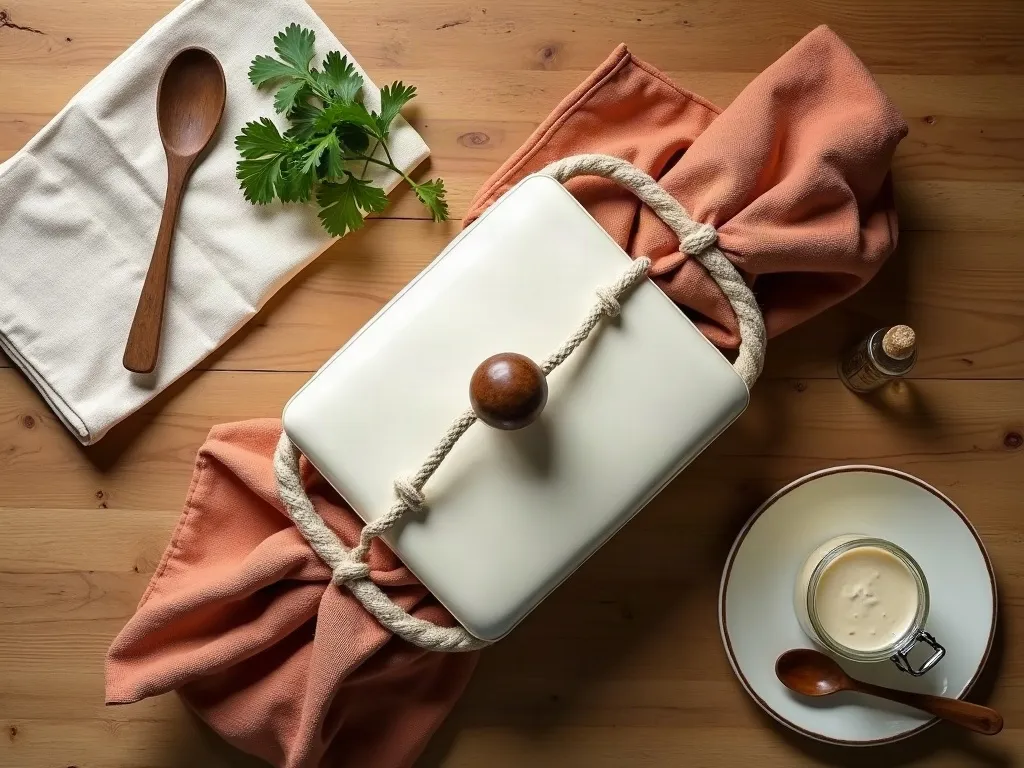
Saturday evening, and the passenger seat of the car holds a covered dish with a folded towel underneath it and a potholder on top, and the whole car smells of onions. This is the season for that. From now until the end of the year a good share of the cooking we do is not for our own table.
We write a great deal about what to cook and how to cook it. Very little about the twenty minutes between one kitchen and another, which is where a surprising number of good dishes quietly go wrong. Not because the recipe was wrong. Because the food was finished at home and then asked to travel.
Heat leaves from the surface
A hot dish does not carry its warmth in the middle. It carries it in the water inside the food, and that warmth leaves from wherever the food meets the air. Which is why the vessel matters more than the recipe for anything that has to arrive hot: a wide shallow platter exposes far more surface than a deep pot with a lid on it, and it will be lukewarm by the time it reaches a doorstep three streets away.
So the pot with a lid beats the pretty open dish, and the folded towel over the lid is not decoration. Neither is the cooler bag, which is the piece of equipment people misread most often. Insulation does not know which direction you want the heat to go. A bag that keeps a cold thing cold will keep a hot thing hot, and if the dish is going to be in the car for the length of a school run, it earns its place on the floor behind the passenger seat.
Two small habits that cost nothing. Rinse the pot with the hottest water from the tap and dry it before the food goes in, the way a thermos gets warmed before a lunch goes into it; a cold pot takes heat out of the dish from the inside. And leave an inch of headroom. A pot filled to the rim arrives with the lid glued on and half the contents in the towel.
Two temperatures in one bag
Most dishes that travel are not one dish. There is the hot part, and then there is the thing that goes on at the end — a jar of dressing, a spoonful of yogurt, the herbs, something crisp.
Those two cannot ride together. The cold thing takes heat out of the hot thing and the hot thing fogs up the cold thing, and by the time the bag is opened both are wrong. It is the same wet-versus-dry rule that makes a packed lunch arrive in one piece, applied to a larger box: cold parts in their own jar, in their own bag, and on a long journey wrapped in a second cloth.
The crisp element wants even more separation, and it has an advantage the rest do not: it can be finished at the other end. Crisp onions, croutons, toasted nuts, a handful of parsley, a squeeze of lemon. A squeeze of lemon at the table is worth more than the same squeeze of lemon in the kitchen, because the acid is still bright when the dish is not.
Assume their kitchen is full
Here is the thing to imagine before you choose what to bring: an oven with something in it, a hob with two pans going, and a counter that is already covered in the host’s own work. Yours is the fifth job in a four-job kitchen.
Which rules out more dishes than people expect. Fried things, anything with a crust or a crisp top, a dressed salad, a dish that needs a last-minute sear or a blast under the grill. What survives is the food that is good warm rather than hot, and that does not mind waiting: a braise, a pot of beans, roasted roots, a grain dish, the meatloaf that slices cleanly because it rests before it is cut. A dish that is only good in its first ten minutes out of the pan is a dish that depends on somebody else’s timing, and their timing is not yours to arrange.
There is a useful corollary. If the last step can be done at the other end, carry it undone and do it there. Ten seconds at a table beats twenty minutes of hoping in a car.
The container is the luggage
Whatever it goes in has to survive a car, a doorstep and a coat hook, which is a harder brief than a shelf in the refrigerator. Lidded beats beautiful. A dish that will be served from its own pot is one less thing to wash at either end, and the empty goes home with you.
Foil pans deserve a word of their own: fine into an oven, poor in a car, because they buckle, they do not seal, and a full one with a lid of foil is a surprise waiting to happen on a bend. The dish you would mind losing should not travel. Neither should the lid you cannot live without.
A strip of tape on the lid is worth the ten seconds. Not for the host, who will be told what it is. For you, at eleven o’clock, in a hallway, deciding which of four containers is yours to take home.
The refrigerator is the real destination
The arrival is not the table. It is somebody’s already-full refrigerator, and that refrigerator is the part of the evening nobody planned for. The dish that needs a whole shelf and a platter’s footprint creates a negotiation in a doorway; the one that stands up on a shelf slides in beside what is already there.
So ask where it should go rather than opening the door and rearranging shelves that are not yours. This is the same space problem as a fridge at the end of a holiday week, only arriving from outside, and the guest who brings a container that fits is a better guest than the one who brings a bigger dish.
Worth saying plainly: if the hot dish arrives early and sits on the counter for a while before dinner, that is not a failure. That is dinner being assembled. It only needs to be on a clock, and the clock is not the host’s to remember.
The plate is on a clock
Once the food is on the table it is out of your hands and out of the refrigerator, and the same two hours that apply at home apply in somebody else’s dining room. As the USDA guidance restated by Fight BAC! puts it, cooked food should not sit at room temperature for more than two hours, and leftovers should be refrigerated within that window and eaten within three to four days.
You cannot manage another household’s table, and it is not your job to try. What you can do is make the next step easy: bring the dish in a container with a lid, so that whatever is left can go straight into the refrigerator instead of being transferred to a plate and forgotten. If the evening is going to be long, bring two smaller containers instead of one large one and hold the second back — cold, lidded, unopened — until somebody thinks about tomorrow.
The way home
The car goes home lighter and it smells of somebody else’s kitchen. There is an empty pot in the boot, a container of something pressed on you at the door, and a potholder that has done its job.
None of that is cooking, exactly. But a dish that arrives intact was never really a test of the recipe. It was a test of containers and timing and one sensible decision made before the pot went on — and those are all far easier to fix than a bad recipe is.